Notes, summaries, assignments, exams, and problems for Visual arts

Sort by
Subject
Level

Visual Language: Essential Qualities and Types of Forms

Classified in Visual arts

Written on in English with a size of 2.78 KB

Essential Qualities of Forms

Forms are divided into several key characteristics:

  • Configuration: Refers to the structure. A two-dimensional form may be triangular, rectangular, square, circular, or irregular. A three-dimensional form may be pyramidal, cubic, spherical, or irregular.
  • Size: Determined by comparison with surrounding objects. For example, an apple is big when compared with a cherry, but small compared with a melon.
  • Material: Refers to the composition of the object, such as wood or stone. It can be hard, soft, light, or heavy.
  • Texture: Indicates the tactile or graphic sensation of the surface. It can be smooth or rough, and the finish is expressed in terms like opaque or bright.
  • Color: A quality that can vary depending on ambient light.
... Continue reading "Visual Language: Essential Qualities and Types of Forms" »

Understanding Color: Light, Pigments, and Perception

Classified in Visual arts

Written on in English with a size of 3.97 KB

The Fundamentals of Color and Its Application

The study of color encompasses its physical characteristics, how it is mixed, and how it is perceived.

Physical Characteristics of Light

Light is a form of energy, a range of electromagnetic radiation. It can be natural or artificial.

The rainbow is a physical phenomenon demonstrating that white light is composed of seven distinct colors: red, orange, yellow, green, blue, indigo, and violet.

Sir Isaac Newton discovered that white light, when passed through a prism, decomposes into these seven colors of the rainbow.

Light Color: Additive Synthesis

Light color mixing is known as additive synthesis. The three primary colors of light are Red, Green, and Blue (RGB). The mixture of these three produces white... Continue reading "Understanding Color: Light, Pigments, and Perception" »

Understanding Polygons: Types, Properties, and Classifications

Classified in Visual arts

Written on in English with a size of 3.93 KB

Polygon

A polygon is a flat geometric figure bounded by a closed traverse that does not intersect itself.

Classifying Polygons

Polygons are basically classified into:

Regular Polygons

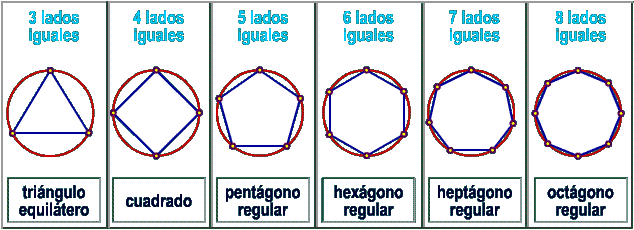
A regular polygon has all sides of equal length and all its vertices lie on a circle. They are classified as:

  • Equilateral Triangle: A regular polygon with 3 sides.
  • Square: A 4-sided regular polygon.
  • Regular Pentagon: A regular polygon with 5 sides.
  • Regular Hexagon: A 6-sided regular polygon.
  • Regular Heptagon: A regular 7-sided polygon.
  • Regular Octagon: An 8-sided regular polygon, and so on.

Regular Polygon

poligonos_regulares.gif

Irregular Polygons

An irregular polygon has sides that are not of equal length and/or its vertices do not lie on a circle. According to... Continue reading "Understanding Polygons: Types, Properties, and Classifications" »

Technical Drawing Principles and Projection Systems

Classified in Visual arts

Written on in English with a size of 3.73 KB

Technical Drawing Features

Core Characteristics

  • Graphic: Lines, symbols, and figures replace words to convey information.
  • Universal: It is understood globally, regardless of the language spoken.
  • Accurate: A set of drawings for a project must correspond exactly during assembly.

Spatial Dimensions

Space is categorized as two-dimensional (length x width) or three-dimensional (length x width x height).

Projection Systems and Definitions

  • Project: To draw a line from the center of projection through an object, intersecting the projection surface to produce an image.
  • Projection of a Point: The intersection where the projecting line passes through a specific point.
  • Projecting a Picture: Drawing straight lines starting from a point that pass through all points
... Continue reading "Technical Drawing Principles and Projection Systems" »

Impressionism and Post-Impressionism: Monet and Cézanne Analysis

Classified in Visual arts

Written on in English with a size of 2.23 KB

Impression Sunrise (1872) - Impressionist Style

Set against a hazy background featuring merchant ships with masts and smoky factory chimneys in the port, the sun is represented by a small, round orange orb. It illuminates the quiet marine waters where three small rowboats approach the viewer. In this painting, Monet dispenses with conventional representation, prioritizing the emotions evoked by the direct observation of natural elements over academic detailing and precise object shaping.

The composition is the result of a series of bright, dynamic brushstrokes that capture a fleeting feeling. A faint blue-gray mist dominates the color palette, contrasting with the orange sun and its reflected light. These complementary colors are intentional,... Continue reading "Impressionism and Post-Impressionism: Monet and Cézanne Analysis" »

Understanding Color Theory: Primary, Secondary, and Harmonious Combinations

Classified in Visual arts

Written on in English with a size of 3.65 KB

The Primary and Secondary Colors

  • Color is an element of visual language.
  • Basic colors, when mixed in different quantities and with the addition of black, can imitate reality.

Primary or Fundamental Colors

  • These are colors that cannot be achieved by mixing any other colors.

Cyan Magenta Yellow

Secondary Colors or Binary

  • Obtained by mixing two primary colors together.

Subtractive Mixture

  • When all primary colors are mixed together, they produce a visual sensation close to black.

Color Wheel and Complementary Colors

  • The color wheel is a pattern formed by a circular geometric figure, used to sort primary and secondary colors for easy visual comprehension.
  • Complementary colors are those opposite each other on the color wheel, meaning they do not contain any
... Continue reading "Understanding Color Theory: Primary, Secondary, and Harmonious Combinations" »

Visual Elements: Point, Line, Plane, & Texture in Art

Classified in Visual arts

Written on in English with a size of 4.76 KB

The Point: Foundation of Visual Form

Defining the Point

The point is the smallest element that can be drawn. Its form is considered indefinite when it is very small, as its shape is conceptually round.

Expressive Capacity of Points

The expressive capacity of the point is demonstrated when a set of points produces an effect of depth or volume. An example of this is concentration, where points grouped closely together can create a sense of density or focus.

Dimensional Capability of Points

The dimensional capability of the point also relates to how a set of points can create an effect of depth or volume. This can be achieved through techniques such as overlap, variations in size, and the use of color.

The Line: A Point in Motion

Understanding the Line

The... Continue reading "Visual Elements: Point, Line, Plane, & Texture in Art" »

Essential English Travel Phrases and Grammar Practice

Classified in Visual arts

Written on in English with a size of 2.02 KB

Travel Planning and Shopping

  • I'm going to Puerto Rico to see my relative. | Is it easy to find bargains online?
  • I need to go shopping to get a suitcase. | It's easy to do.
  • I have to go online to find a flight. | It's not hard to do.

Packing Essentials

  • What should I take? | Do you want to pack some other shoes?
  • Should I take these shoes? | Why don't you take a hat?
  • You should take a hat. | It's a good idea to pack a jacket.
  • You shouldn't take high heels. | Take a flashlight.
  • You could borrow your dad's hat. | Don't forget to pack some batteries.
  • You need to have warm clothes.

Possessive Pronouns and Adjective Order

  • It's my / mine | Opinion, size, color, shape, nationality, material
  • They're your / yours | They have beautiful Turkish rugs.
  • Her / hers | I like
... Continue reading "Essential English Travel Phrases and Grammar Practice" »

Technical Drawing Systems and Projection Methods

Classified in Visual arts

Written on in English with a size of 2.76 KB

Dihedral System

A representation system using cylindrical projection angles.

Elements

  • Two perpendicular planes of projection: Vertical plane and horizontal plane.
  • Intersection: The line between the vertical and horizontal planes.

Objects can be represented as points, straight lines, or solid plane figures. Their projections are called:

  • Elevation (Front view)
  • Plan (Top view)
  • Profile (Side view)

Dimensioning Standards

Normalization is a set of graphic rules with the objective of facilitating international comprehension of technical drawings. Dimensioning marks the measurements of a piece using lines and numbers.

Bounding Elements

  • Dimension lines
  • Auxiliary or reference lines
  • Dimension numbers

Dimensioning Systems

  • Parallel
  • Series
  • Combined

Detailed Drafts

Freehand... Continue reading "Technical Drawing Systems and Projection Methods" »

Fundamentals of Graphic Design: Lines, Planes, and Symmetry

Classified in Visual arts

Written on in English with a size of 2.45 KB

The Graphic Line

A line is generated by the motion of a point along a path, creating length and width, while thickness is often considered a secondary dimension. The visual qualities of a line depend on its trajectory, which can be straight, curved, broken, or mixed.

Geometric Paths

Straight paths follow mathematical laws and are created using drafting tools. When a graphic line changes direction and returns to its starting point, it generates an area and perimeter, forming shapes such as squares, triangles, and circles. Combining these creates both regular and irregular forms.

Visual Qualities of the Graphic Plane

The form of a plane depends on the line defining its perimeter. Key characteristics include:

  • Size: Defined in relation to the graphic
... Continue reading "Fundamentals of Graphic Design: Lines, Planes, and Symmetry" »