Notes, summaries, assignments, exams, and problems for Biology

Sort by
Subject
Level

Detailed Human Anatomy: Muscles, Nerves, and Brain Structures

Classified in Biology

Written on in English with a size of 12.15 KB

Muscles of the Head and Neck

Facial Muscles

  • Frontalis
  • Orbicularis oculi
  • Nasalis
  • Zygomaticus major
  • Zygomaticus minor
  • Levator labii superioris
  • Levator anguli oris
  • Orbicularis oris
  • Depressor labii inferioris
  • Depressor anguli oris
  • Mentalis
  • Buccinator
  • Occipitalis

Muscles of Mastication

  • Masseter
  • Temporalis

Neck Muscles

  • Platysma
  • Sternocleidomastoid
    • Origin: Sternum and clavicle
    • Insertion: Mastoid process of the temporal bone
    • Action: (Not specified)
    • Nerve: CN XI (Accessory nerve)
  • Omohyoid
  • Sternohyoid
  • Sternothyroid
  • Thyrohyoid
  • Scalenes

Anatomy of the Eye

Extrinsic Eye Muscles

  • Superior rectus: CN III (Oculomotor nerve)
  • Inferior rectus: CN III (Oculomotor nerve)
  • Lateral rectus: CN VI (Abducens nerve)
  • Medial rectus: CN III (Oculomotor nerve)
  • Superior oblique: CN IV (Trochlear nerve)
  • Inferior
... Continue reading "Detailed Human Anatomy: Muscles, Nerves, and Brain Structures" »

Essential Nutrients and Human Body Functions

Classified in Biology

Written on in English with a size of 3.25 KB

Why Humans Need to Eat

  • Molecules in food contain chemical energy that cells use to produce ATP (Adenosine Triphosphate).
  • Food supplies raw materials your body needs to build and repair tissues.

Six Essential Nutrients the Body Needs

The six essential nutrients required by the body are:

  • Carbohydrates
  • Water
  • Proteins
  • Fats (Lipids)
  • Vitamins
  • Minerals

Saturated vs. Unsaturated Fats

Similarities

Both saturated and unsaturated fats are lipids made from glycerol and fatty acids (chains of carbon and hydrogen molecules).

Differences

  • Saturated fats are typically solids at room temperature.
  • Unsaturated fats are usually liquids at room temperature.

Using Food Labels for a Balanced Diet

Food labels are crucial for planning a healthful diet. They help consumers determine if... Continue reading "Essential Nutrients and Human Body Functions" »

Key Characteristics of Vertebrate Animal Groups

Classified in Biology

Written on in English with a size of 3.7 KB

Main Characteristics of Vertebrate Animals

Vertebrate animals belong to the Animal Kingdom and possess the following characteristics:

  • They have an internal skeleton that allows movement, protects the organs, and gives support to their body.
  • They have blood to carry nutrients and waste products throughout the body.
  • They have articulated limbs (fins, wings, or legs).

We are going to study the following vertebrate groups:

Classification and Features of Fish

  • Aquatic: They have a fusiform body (thinner at the tips) and fins. They breathe through gills.
  • Poikilothermic: They cannot maintain a constant body temperature.
  • Lateral line: A line crossing their body that is able to detect vibrations in the water.
  • External fertilization: Gametes join in the environment,
... Continue reading "Key Characteristics of Vertebrate Animal Groups" »

Introduction to Ecosystems and Ecology

Classified in Biology

Written on in English with a size of 3.31 KB

Ecosystem

An ecosystem is a community of plants and animals (living things) that interact with each other and their natural surroundings, including non-living things such as rocks, water, and air. Each ecosystem is sustained by a flow of energy through it and the recycling of nutrients within it.

Community

When plants and animals live together, they form a community.

Photosynthesis

Photosynthesis is the process in which plants absorb CO₂ from the air and convert it into sugar using the sun's energy.

Biomes

Biomes are large ecosystems at the global scale where the climate and vegetation are uniform.

Xerophytic Plants

Xerophytes are plants that have adapted by altering their physical structure to survive in harsh climates. These plants exhibit several... Continue reading "Introduction to Ecosystems and Ecology" »

The Interaction Function: Perception, Processing, and Response

Classified in Biology

Written on in English with a size of 2.57 KB

The Interaction Function

The interaction function enables people to perceive changes and stimuli that occur both inside their bodies and their environment, to interpret or process them and generate coordinated responses in order to survive.

1.1 Perceiving Stimuli

The interaction function can be divided into 3 stages: perception of stimuli, processing of the information and generation of responses.

A stimulus is a physical or chemical change that takes place outside or inside the body and triggers a response in it.

Our bodies contain specialist cells, called receptors, which perceive stimuli and send the information they detect to the coordination centres.

Types of Receptors

  • Internal receptors perceive changes inside the body, such as a rise in blood
... Continue reading "The Interaction Function: Perception, Processing, and Response" »

Plant Water Absorption and Cellular Transport Processes

Classified in Biology

Written on in English with a size of 2.57 KB

Absorption by the Roots

Key Biological Definitions

  1. Imbibition: It is the phenomenon by which a living or a dead cell absorbs water through surface attraction.
  2. Diffusion: It is the free movement of molecules of a substance from a region of higher concentration to lower concentration when the two are in direct contact.
  3. Osmosis: It is the process of movement of water molecules from a region of higher concentration to a region of lower concentration through a semi-permeable membrane.
  4. Endosmosis: It is the inward diffusion of water through a semi-permeable membrane when the surrounding solution is less concentrated.
  5. Exosmosis: It is the outward diffusion of water through a semi-permeable membrane when the surrounding solution is more concentrated.
  6. Osmotic
... Continue reading "Plant Water Absorption and Cellular Transport Processes" »

Motor Control: Pathways, Neurons, and Muscle Function

Classified in Biology

Written on in English with a size of 4.33 KB

Muscle spindles stimulate stretch, while Golgi tendon organs stimulate muscle contraction. Cerebellar tremor is characterized by low frequency. Motor pathways begin in the cerebral cortex and brainstem. Lower spinal cord motoneurons innervate skeletal muscles, including extrafusal and intrafusal fibers. Stimulation of muscle spindles or Golgi tendon organs is accomplished through the reticulospinal tract.

Muscle Tone and Movement Disorders

  • Hypotonia: Decreased muscle tone
  • Dyskinesia: Atypical, unconscious muscle movement
  • Hypertonia: Increased muscle tone
  • Spasticity: Hyper-contraction of muscles
  • Akinesia: Atypical unconscious posture

Cortical Control of Movement

Layer V contains pyramidal neurons. The primary motor cortex contains smaller and fewer... Continue reading "Motor Control: Pathways, Neurons, and Muscle Function" »

Anatomical Directions, Planes and Major Body Cavities

Classified in Biology

Written on in English with a size of 3.5 KB

Muscular Origins & Insertions (Quick Study Academic): BarCharts, Inc.:  9781572227545: Amazon.com: Books

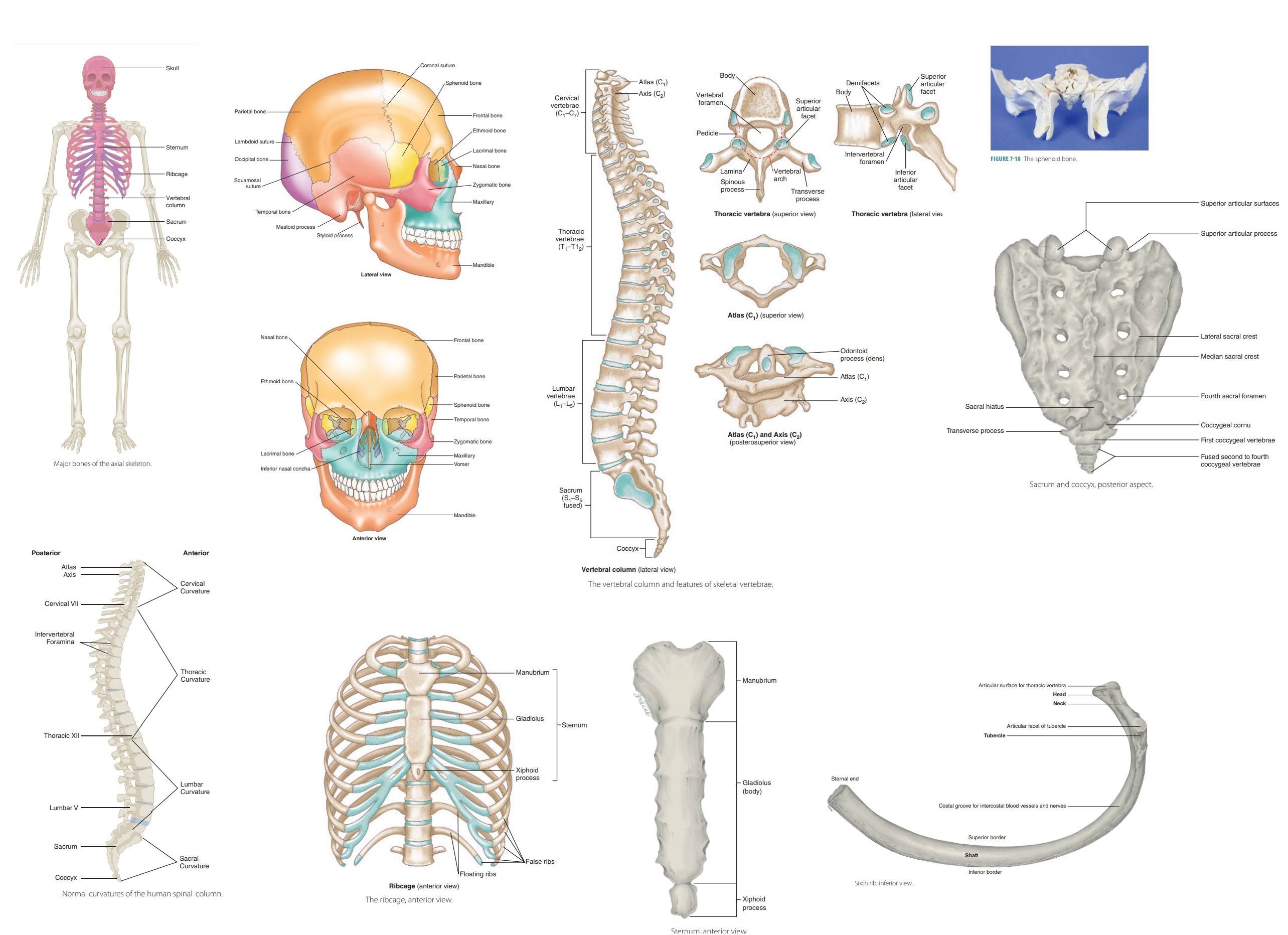
Axial Skeleton - Skeletal Organization 13 Biomechanics of Joints | Musculoskeletal Key

Anatomical Directions and Terms

  • Anterior (ventral): Toward the front of the body.
  • Posterior (dorsal): Toward the back of the body.
  • Superior: A part above another part.
  • Inferior: A part below another part.
  • Medial: Toward the midline (median plane) of the body.
  • Lateral: Away from the midline of the body; toward the sides.
  • Proximal: Toward the point of attachment to the body.
  • Distal: Away from the point of attachment to the body.
  • Deep: Toward the inside of the body.
  • Superficial: Toward the outside of the body.
  • Parietal: A membrane that covers an internal body wall.
  • Visceral: A membrane that covers an organ.

Body Planes

Sagittal: The plane that runs down through the body, dividing it into left and right portions. Subsections of the sagittal plane include:

... Continue reading "Anatomical Directions, Planes and Major Body Cavities" »

Understanding DNA Replication, Transcription, and Translation

Classified in Biology

Written on in English with a size of 744 bytes

Replication

AAGGCCTAGC-TTCCGGATCG

Transcription

AAGGCCTAGC

-UUCCGGAUCG;

Translation

How to Read the RNAm to Make Proteins After the Transcribing DNA as RNAm

It exists from the nucleus to the cytoplasm. There, ribosomes are waiting for the RNAm, and the two subunits look for the first codon AUG. The RNAm is read by triplets. All the possible combinations of codons and its corresponding amino acids are called genetic code. Mutation is the alteration of the DNA sequence that can be transmitted to the offspring (if it occurs in gametes).

Addition:

A nucleotide is added

Deletion:

A nucleotide is removed

Substitution:

A nucleotide is changed

Fungi, Animals, and Ecosystems: A Comprehensive Study

Classified in Biology

Written on in English with a size of 7.54 KB

  1. Fungi obtain nutrients through absorption.
  2. The body of most fungi consists of threadlike hyphae, which form a network called a mycelium.
  3. Some fungal species live in plants and can kill herbivores that feed on the plant. What type of relationship does this fungus have with its host? Mutualistic
  4. What sexual processes in fungi generate genetic variation? Karyogamy and meiosis
  5. Almost all of the members of this phylum form arbuscular mycorrhizae in a mutualistic partnership with plants. Glomeromycota
  6. From the human perspective, which of the following kinds of fungi would be considered the least useful or beneficial? Rusts
  7. Which of the following best describes the physical relationship of the partners involved in lichens? Photosynthetic cells are
... Continue reading "Fungi, Animals, and Ecosystems: A Comprehensive Study" »