Essential Algebra and Calculus Formulas and Concepts
Classified in Mathematics
Written on in  English with a size of 3.96 KB
Coordinate Geometry Formulas
For points A(x1, y1) and B(x2, y2), the distance formula is:
d = √[(x2 - x1)2 + (y2 - y1)2]
Midpoint formula: ((x1 + x2)/2, (y1 + y2)/2)
Functions and Calculus Basics
- Difference quotient: f(x+h) - f(x) / h
- X-intercepts: Not imaginary, written as (x, y).
- Solutions/Roots/Zeros: Can be imaginary, written as x = ___.
Financial and Parent Functions
- Compound interest: A = P(1 + r/n)nt (r must be a decimal).
- Continuous compound interest: A = Pert
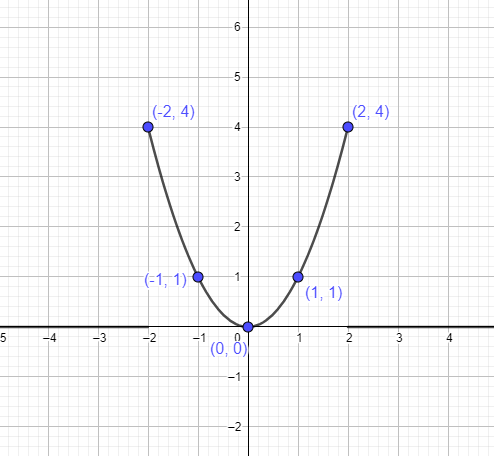
- Parent function y = x2: Domain: all real numbers, Range: y ≥ 0.
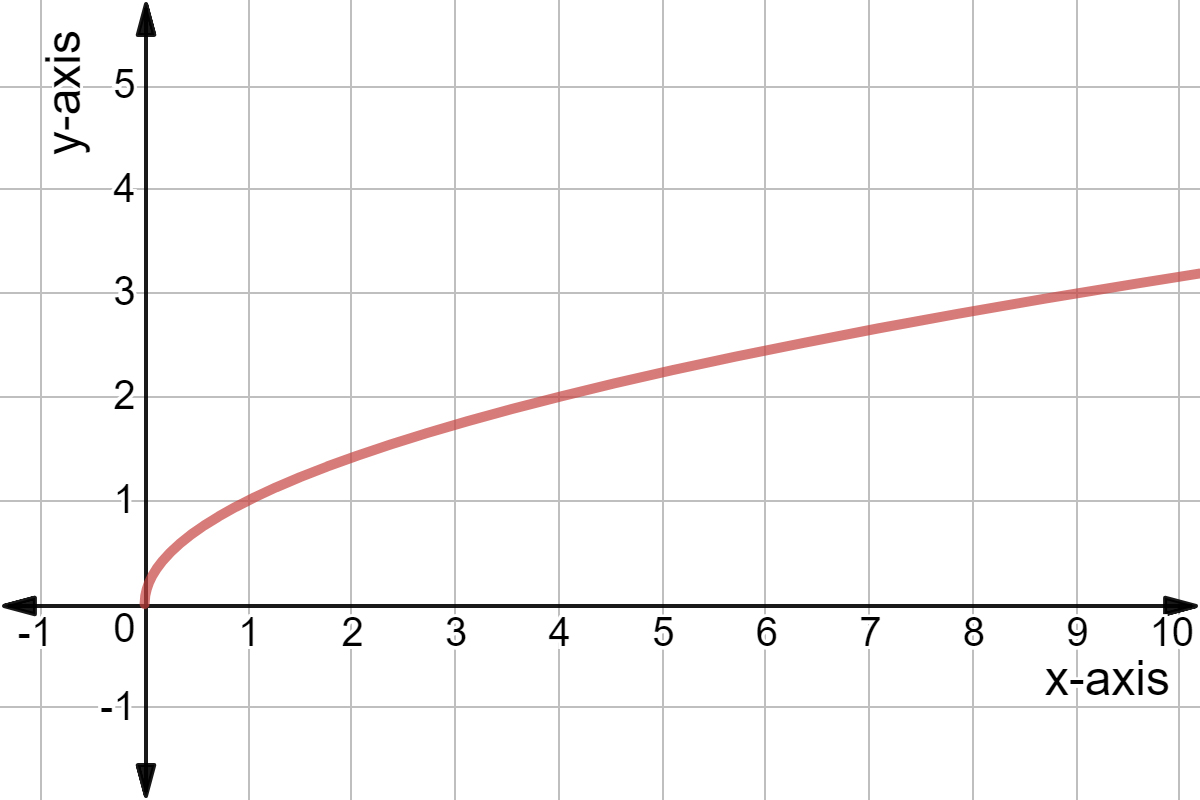
- Parent function y = √x: Domain: inside ≥ 0, Range: y ≥ 0.
Transformations and Analysis
Key: For transformations, ensure x inside parentheses is always positive; factor negatives out front.
- h(x) = -32(x+4): Left 4, flip over x-axis, horizontal compress by 2.
- f(x) = 3ex+1: Left 1, vertical stretch by 3.
- g(x) = 2-x+1: Up 1, flip over y-axis.
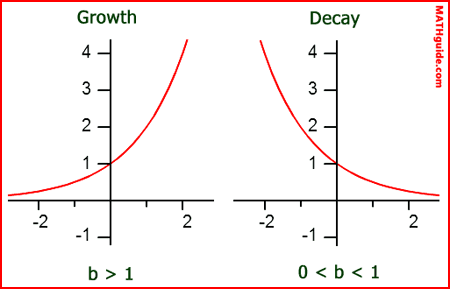
Note: f(x) = 2x (growth) vs 2-x (decay).
Advanced Concepts
- Local min/max: Write as (x, y).
- Increasing/decreasing intervals: Write in terms of x.
- Inverse functions f-1(x): Switch x and y, then solve for y. Include the domain of both the function and the inverse.
- Composition: (f ∘ g) = f(g(x)).
- Interval notation: Use (-∞, 2) ∪ (2, ∞). Use brackets [ ] only when the value is an x-intercept and the inequality includes "equal to". Use parentheses for infinity or non-inclusive values.
- Point-slope form: Y = y1 + m(X - x1).
- Parallel lines: Same slopes.
- Perpendicular lines: Negative reciprocal slopes.
Quadratic and Complex Solutions
Revenue: R = price × items sold. Find the vertex to determine the ideal price.
Complex numbers: If you have one imaginary root, there must be another. Factor until imaginaries are gone. Powers of i: i1=i, i2=-1, i3=-i, i4=1 (cycle repeats).
Completing the Square (CTS): Move the constant to the right, take half of the x-coefficient, square it, add to both sides, rewrite as a squared term, and solve.
Exponential and Rational Functions
Exponential graph f(x) = ax (a > 0, a ≠ 1): Domain: (-∞, ∞), Range: (0, ∞), y-intercept: (0, 1), Horizontal Asymptote: y = 0.
Asymptote Rules
- Hole: Cancel common factors in numerator and denominator, then solve for y.
- Vertical Asymptote (VA): Set denominator to 0.
- Horizontal Asymptote (HA):
- Same degree: Divide leading coefficients.
- Small/Big: HA is y = 0.
- Big/Small: No HA (check for slant asymptote via division).