
Electromagnetism Fundamentals: Motors, Charges, and Fields
Classified in Physics
Written on in  English with a size of 5.62 KB
Understanding Electromagnets
An electromagnet is a temporary artificial magnet that produces a magnetic field when an electrical current flows through it, which disappears when the current stops. Its advantages include:
- Controllability: Intensity can be adjusted by varying the current.
- Coil Density: Magnetic strength increases with the number of solenoid turns.
- Polarity: Can be reversed by changing the direction of the current flow.
The Solenoid or Coil
A solenoid is a conductor wound in spirals, forming a helix. When electric current flows through it, the solenoid generates an intense magnetic field in its interior, with lines of force parallel to the solenoid's axis.
Electrical Charge
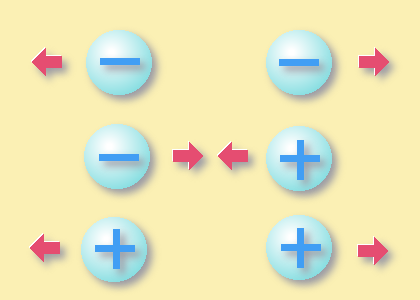
Electrical charge is an intrinsic property of subatomic particles (gained or lost via electrons) manifested through attraction and repulsion, which determines electromagnetic interactions. Matter becomes electrically charged through influence, which in turn generates these interactions.
Electrical Power
Electrical power is the amount of energy delivered or absorbed by an element in a given time. The unit in the International System of Units is the Watt.
Electric Motors
An electric motor is a machine that converts electrical energy into mechanical energy through electromagnetic interactions. Some electric motors are reversible, meaning they can transform mechanical energy into electrical energy to operate as generators.
Electrification by Friction
When two neutral bodies (equal number of electrons and protons) are rubbed together, both become charged—one positively and one negatively. For example, rubbing a glass rod with silk transfers electrons from the glass to the silk. Similarly, rubbing a plastic pen with wool transfers electrons from the cloth to the pen. The glass gains a positive charge by losing electrons, while the silk becomes saturated with negative charges. These charged bodies exert force in an area known as an electric field, which depends on the amount of charge gained or lost.
Electrification by Contact
Any body can become electrified through direct contact with another body that is already electrified.