
Computer Systems Fundamentals Cheat Sheet
Classified in Computers
Written on in  English with a size of 3.88 KB

Computer Systems Fundamentals Cheat Sheet
Number Systems
- Binary (Base 2): Digits 0 and 1.
- Hexadecimal (Base 16): Digits 0–9 and A–F.
- Decimal (Base 10): Digits 0–9.
Conversions
- Binary to Decimal: Multiply each bit by 2^n from the right.
- Decimal to Binary: Divide by 2 and record the remainders.
- Hex to Binary: Replace each hex digit with its 4-bit binary equivalent.
Two's Complement (Signed Numbers)
- Positive numbers: Same as unsigned.
- Negative numbers: Invert all bits and add 1.
- Range (n bits): -2^(n-1) to 2^(n-1) - 1.
- Overflow: Occurs if carry into the sign bit ≠ carry out.
Boolean Algebra Rules
- Identity: A + 0 = A, A * 1 = A
- Null: A + 1 = 1, A * 0 = 0
- Idempotent: A + A = A, A * A = A
- Inverse: A + NOT A = 1, A * NOT A = 0
- Distributive: A(B + C) = AB + AC
- Absorption: A + AB = A
- DeMorgan's Laws: NOT(A * B) = NOT A + NOT B, NOT(A + B) = NOT A * NOT B
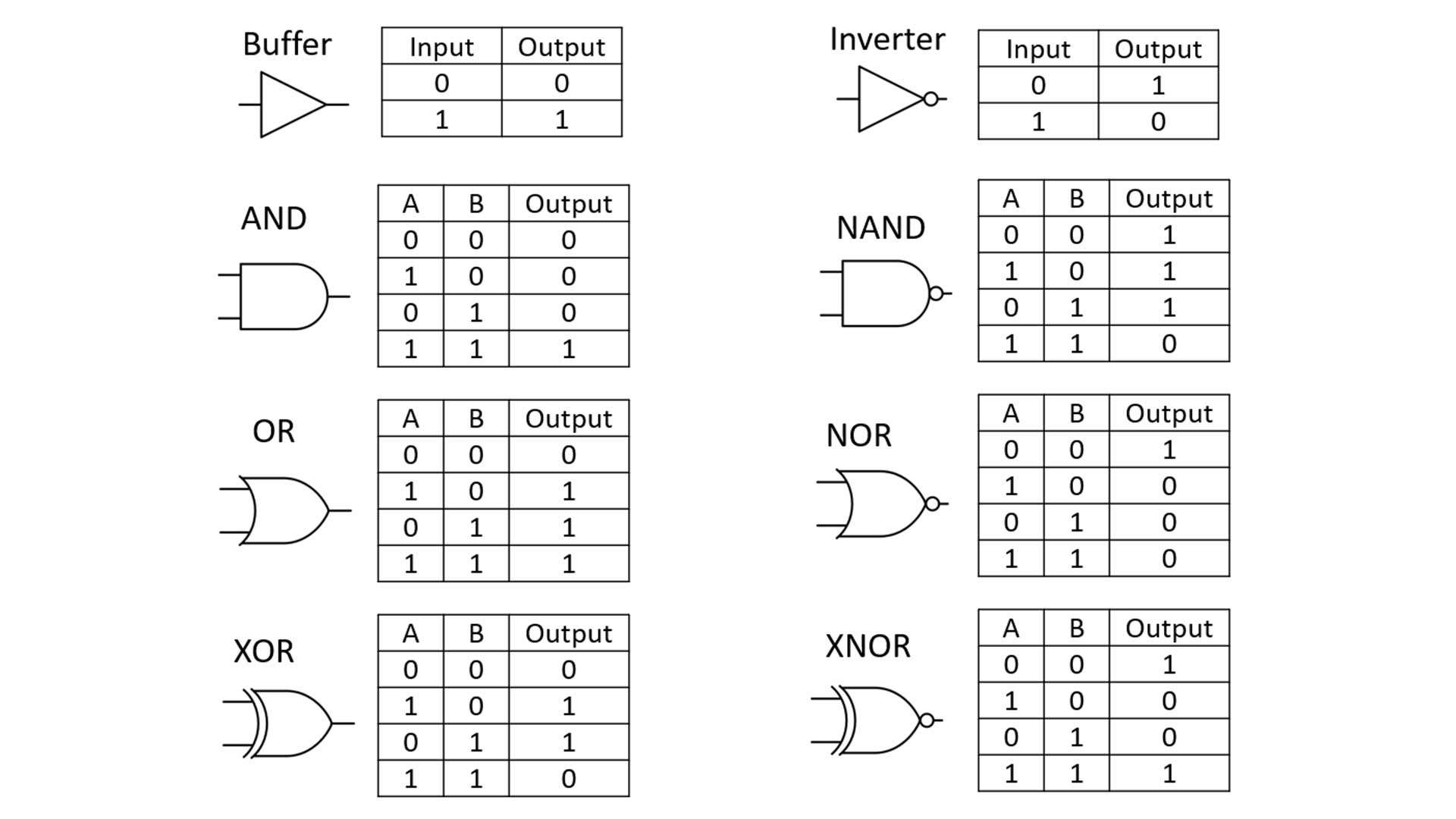
Logic Gates
- NOT: Inverts the input.
- AND: A * B (True if both inputs are 1).
- OR: A + B (True if any input is 1).
- NAND: NOT(A * B).
- NOR: NOT(A + B).
- XOR: A XOR B = A(NOT B) + (NOT A)B.
- XNOR: NOT(A XOR B).
Karnaugh Maps (K-Maps)
- Group 1’s into rectangles (sizes of 1, 2, 4, 8...).
- Bigger groups result in simpler expressions.
- Cover all 1’s with the fewest groups possible.
Latches and Flip-Flops
- SR Latch: Level-sensitive memory (Set/Reset).
- D Latch: Level-sensitive, stores a single bit.
- D Flip-Flop: Edge-triggered, stores a bit on the clock edge.
Finite State Machines (FSM)
- Mealy Machine: Output depends on both state and input.
- Moore Machine: Output depends on state only.
Multiplexers (MUX)
- Select 1 of many inputs based on selector lines.
- Formula (2-to-1 MUX): F = S * D1 + (NOT S) * D0.
Decoders
- n inputs produce 2^n outputs.
- Only one output is high at a time.
Adders
Half Adder
- Sum: A XOR B.
- Carry: A * B.
Full Adder
- Sum: A XOR B XOR Cin.
- Carry-out: AB + ACin + BCin.
Transistor Costs (Common Gates)
- NOT: 2 transistors.
- AND (2-input): 6 transistors.
- OR (2-input): 6 transistors.
- NAND (2-input): 4 transistors.
- NOR (2-input): 4 transistors.
- XOR (2-input): 8 transistors.
- XNOR (2-input): 8 transistors.
General Tips
- Look for patterns in truth tables.
- Group like terms in Boolean expressions.
- Use K-Maps for minimizing expressions.
- Think modularly when designing circuits (using MUXes, decoders, etc.).
- Always check for overflow in binary arithmetic.