
Notes, summaries, assignments, exams, and problems for Visual arts

Sort by
Subject
Level

Understanding Color: Light, Pigments, and Perception

Classified in Visual arts

Written on in English with a size of 3.97 KB

The Fundamentals of Color and Its Application

The study of color encompasses its physical characteristics, how it is mixed, and how it is perceived.

Physical Characteristics of Light

Light is a form of energy, a range of electromagnetic radiation. It can be natural or artificial.

The rainbow is a physical phenomenon demonstrating that white light is composed of seven distinct colors: red, orange, yellow, green, blue, indigo, and violet.

Sir Isaac Newton discovered that white light, when passed through a prism, decomposes into these seven colors of the rainbow.

Light Color: Additive Synthesis

Light color mixing is known as additive synthesis. The three primary colors of light are Red, Green, and Blue (RGB). The mixture of these three produces white... Continue reading "Understanding Color: Light, Pigments, and Perception" »
Understanding Polygons: Types, Properties, and Classifications

Classified in Visual arts

Written on in English with a size of 3.93 KB

Polygon

A polygon is a flat geometric figure bounded by a closed traverse that does not intersect itself.

Classifying Polygons

Polygons are basically classified into:

Regular Polygons

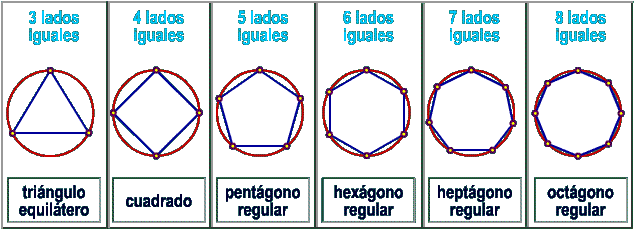
A regular polygon has all sides of equal length and all its vertices lie on a circle. They are classified as:

  • Equilateral Triangle: A regular polygon with 3 sides.
  • Square: A 4-sided regular polygon.
  • Regular Pentagon: A regular polygon with 5 sides.
  • Regular Hexagon: A 6-sided regular polygon.
  • Regular Heptagon: A regular 7-sided polygon.
  • Regular Octagon: An 8-sided regular polygon, and so on.

Regular Polygon

poligonos_regulares.gif

Irregular Polygons

An irregular polygon has sides that are not of equal length and/or its vertices do not lie on a circle. According to... Continue reading "Understanding Polygons: Types, Properties, and Classifications" »

Understanding Color Theory: Primary, Secondary, and Harmonious Combinations

Classified in Visual arts

Written on in English with a size of 3.65 KB

The Primary and Secondary Colors

  • Color is an element of visual language.
  • Basic colors, when mixed in different quantities and with the addition of black, can imitate reality.

Primary or Fundamental Colors

  • These are colors that cannot be achieved by mixing any other colors.

Cyan Magenta Yellow

Secondary Colors or Binary

  • Obtained by mixing two primary colors together.

Subtractive Mixture

  • When all primary colors are mixed together, they produce a visual sensation close to black.

Color Wheel and Complementary Colors

  • The color wheel is a pattern formed by a circular geometric figure, used to sort primary and secondary colors for easy visual comprehension.
  • Complementary colors are those opposite each other on the color wheel, meaning they do not contain any
... Continue reading "Understanding Color Theory: Primary, Secondary, and Harmonious Combinations" »

Visual Elements: Point, Line, Plane, & Texture in Art

Classified in Visual arts

Written on in English with a size of 4.76 KB

The Point: Foundation of Visual Form

Defining the Point

The point is the smallest element that can be drawn. Its form is considered indefinite when it is very small, as its shape is conceptually round.

Expressive Capacity of Points

The expressive capacity of the point is demonstrated when a set of points produces an effect of depth or volume. An example of this is concentration, where points grouped closely together can create a sense of density or focus.

Dimensional Capability of Points

The dimensional capability of the point also relates to how a set of points can create an effect of depth or volume. This can be achieved through techniques such as overlap, variations in size, and the use of color.

The Line: A Point in Motion

Understanding the Line

The... Continue reading "Visual Elements: Point, Line, Plane, & Texture in Art" »

Fundamentals of Visual Elements: Point, Line, Texture, Color

Classified in Visual arts

Written on in English with a size of 3.92 KB

Point and Line as Visual Elements

The point is the simplest plastic element. It can take many forms and can have smooth or jagged edges. As an expressive element, a point can achieve chiaroscuro effects, suggest different textures and volume, and serve as a compositional element to create visual tension or suggest motion and direction.

The line is defined as the mark left when a point slips over the work surface. A line can be smooth or irregular and functions as an expressive element. It can be uniform, objective, or subjective. Lines can be modulated, broken, vertical or horizontal, bending or curved, or straight. Lines can also be used to embed figures within compositions by drawing support with simple geometric terms. A line can be closed... Continue reading "Fundamentals of Visual Elements: Point, Line, Texture, Color" »

Essential Cocktail & Mocktail Recipes for Any Occasion

Classified in Visual arts

Written on in English with a size of 4.52 KB

Gallon Margarita Recipe

Ingredients

  • 3 bottles of Tequila (a budget-friendly option like Sauza works well)
  • 3/4 bottle of Triple Sec (orange liqueur)
  • 1 liter of freshly squeezed lemon or lime juice
  • 1 liter of orange juice
  • 1 liter of simple syrup (pre-mixed or homemade)
  • 4 liters of water

Gallon Daiquiri Recipe

Ingredients

  • 3 bottles of white rum
  • 1.5 liters of simple syrup
  • 1.5 liters of freshly squeezed lemon or lime juice
  • 4 liters of water

Piña Colada Recipe

Ingredients

  • 2 scoops of coconut ice cream
  • 1 part white rum
  • Pineapple juice
  • Crushed ice

Instructions

  1. Combine all ingredients in a blender.
  2. Blend until smooth and the ice is finely crushed.
  3. Serve in a tulip glass.

Pisco Sour Recipe

Ingredients

  • 1 egg white
  • 1 shot of Pisco (e.g., Demonio de los Andes)
  • Simple syrup (to taste)
... Continue reading "Essential Cocktail & Mocktail Recipes for Any Occasion" »

Mastering Color Theory, Light, and Shadow in Art

Classified in Visual arts

Written on in English with a size of 2.96 KB

Understanding Color and Its Properties

Color is a surface quality associated with objects. It depends on light and the sense of vision.

Primary, Secondary, and Tertiary Colors

  • Primary colors: These are colors that are not created from the mixture of other colors. They include magenta, cyan, and medium yellow.
  • Secondary colors: These result from the mixture of two primary colors.
  • Complementary colors: These are the most contrasting pairs and are those positioned opposite each other on the chromatic circle.
  • Tertiary colors: These are composed of a primary color mixed with a secondary color.

Temperature and Emotional Expression

  • Cold colors (Cold range): These express chill or melancholy and include blue, green, and violet.
  • Warm colors (Warm range): These
... Continue reading "Mastering Color Theory, Light, and Shadow in Art" »

Understanding Color: Rainbows, Light, Pigments, and Saturation

Classified in Visual arts

Written on in English with a size of 2.45 KB

Understanding Color: Rainbows, Light, and Pigments

A rainbow occurs when sunlight passes through raindrops, separating the light into seven colored lights.

Absorption conveys the feeling of color when light illuminates an object. The object's surface absorbs some of the light. This property is called the absorption of light.

Reflection is when light is not absorbed but rejected, changing direction and creating the sensation of color.

Color is the name for each color and describes the colors that comprise their mixture (e.g., yellow and green make yellow-green).

Value and Saturation

Value describes the degree of clarity or obscurity of a tone, i.e., the amount of white or black in the composition. For example, magenta can be light, dark, or very dark.... Continue reading "Understanding Color: Rainbows, Light, Pigments, and Saturation" »

Map Projections: Types, Functions, and Uses in GIS with GPS

Classified in Visual arts

Written on in English with a size of 2.68 KB

Map Projection

A map projection is a system of ordered correspondence between points on the curved surface of the Earth and a flat surface. These points are located on a network of meridians and parallels, in the form of a mesh (creating a series of distortions). Good projections must have two characteristics: to retain the areas (equivalence) and retain angles (conformity). Depending on which point is considered the center of the map, it is distinguished between:

  • Polar projection: The center is one of the poles.
  • Equatorial projection: The center is the intersection between the Equator and a meridian.
  • Oblique or slanted projection: The center is any other point.

Functions of the Projections

Conformal Projections

A map projection is conformal when... Continue reading "Map Projections: Types, Functions, and Uses in GIS with GPS" »

Visual Communication, Color Theory, and Geometry

Classified in Visual arts

Written on in English with a size of 4.41 KB

Communication and Its Functions

Communication: This process involves a transmitter, channel, benchmark, code, message, and receiver.

Functions:

  • Insight: To transmit information, such as a green road traffic light.
  • Free-expression: To vent our feelings, such as the Twin Towers or being a fan outdoors.
  • Health: To express beauty and harmony, such as a landscape.
  • Representative: To represent the reality created by humans, such as a street.

Signs, Symbols, and Branding

Signs and Symbols:

  • Sign: A representation of a single image or idea that conveys information by which we understand its representation.
  • Symbol: A sign that represents reality in an abstract way, providing ideas to be known to understand its meaning.

Types of Signs:

  • Brand: A distinctive source
... Continue reading "Visual Communication, Color Theory, and Geometry" »