Vernier Caliper Measurements, Significant Figures & Capacitors
Classified in Chemistry
Written on in  English with a size of 4.4 KB
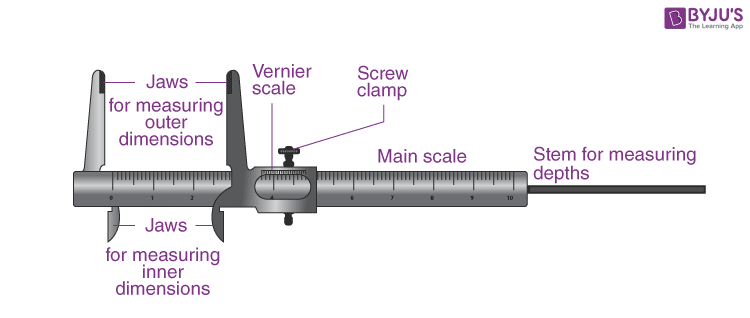
Vernier Caliper
A Vernier caliper is an instrument for making very accurate linear measurements introduced in 1631 by Pierre Vernier of France. It uses two graduated scales: a main scale similar to that on a ruler and an auxiliary scale, the vernier, which slides parallel to the main scale and enables readings to be made to a fraction of a division on the main scale. Vernier calipers are widely used in scientific laboratories and in manufacturing for quality-control measurements.
Five Rules for Determining Significant Figures
- Non-zero digits are significant. For example, in 6575 cm there are four significant figures; in 0.543 there are three significant figures.
- Leading zeros are not significant. Zeros that precede the first non-zero digit indicate the location of the decimal point. In 0.005 there is only one significant figure; in 0.00232 there are three significant figures.
- Zeros between non-zero digits are significant. For example, 4.5006 has five significant figures.
- Trailing zeros are significant if they are to the right of the decimal point. For example, 0.500 has three significant figures. (Use scientific notation to avoid ambiguity when necessary.)
- Exact counts have infinite significant figures. Counting discrete objects, e.g., 5 bananas or 10 oranges, yields exact numbers and are considered to have an infinite number of significant figures.
Accuracy
Accuracy is the ability of an instrument to measure the true or accepted value. In other words, accuracy is the closeness of a measured value to a standard or true value.
Precision
Precision is the closeness of two or more measurements to each other. For example, if you weigh a given substance five times and get 3.2 kg each time, your measurements are very precise but not necessarily accurate. Precision is independent of accuracy.
Series Combination of Capacitors
When one terminal of a capacitor is connected to the terminal of another capacitor, the arrangement is called a series combination of capacitors. In series, each capacitor carries the same charge transferred from the battery.
The three capacitors C1, C2 and C3 are in series.
Charge on the first capacitor: Q1 = C1 V1
Charge on the second capacitor: Q2 = C2 V2
Charge on the third capacitor: Q3 = C3 V3.
In series, the charges are equal: Q1 = Q2 = Q3 = Q. If we denote the equivalent capacitance by Ceq and the total voltage by V, then Q = Ceq · V.
The voltages across the capacitors add: V = V1 + V2 + V3.
For capacitors in series, the formula for equivalent capacitance is:
1 / Ceq = 1 / C1 + 1 / C2 + 1 / C3
Equivalently, Ceq = 1 / (1 / C1 + 1 / C2 + 1 / C3).

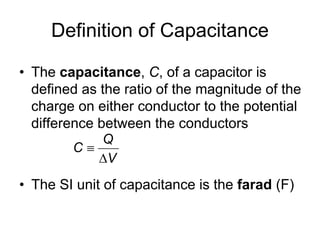
Capacitor
A capacitor is a two-terminal electrical device that can store energy in the form of an electric charge. It consists of two electrical conductors that are separated by a distance. The space between the conductors may be vacuum or an insulating material known as a dielectric.