
Industrial Revolution: Agricultural, Demographic and Economic Causes
Classified in Geography
Written on in  English with a size of 5.17 KB
The Industrial Revolution includes all the changes to goods production and consumption resulting from the incorporation of machines into industrial manufacturing.
- Occurred over a long period of time
- Slow and constant progress
- Affected other sectors
- Changed the economy and society
The Industrial Revolution began in Great Britain around 1870 due to favourable economic and demographic factors.
- Agricultural Revolution
- Demographic Revolution
- Modernisation of transport
- Growth of financial means
- Availability of energy sources and raw materials
Agricultural Revolution
Changes in the system of land ownership in Britain and technical advances led to transformations in agricultural activities.
- Technical progress
- Triennial (three-field) rotation was replaced by the Norfolk four-course system
- Continuous rotation of four sections:
- Wheat (for bread)
- Turnips (helped to replenish the soil and were used to feed livestock)
- Barley (used for beer, meal, and fodder)
- Forage (alfalfa and clover, used as fodder)
- Allowed for increased livestock farming
- Provided more fertilisers (increased crop production)
- Increased meat and milk production (improved human diets)
- Continuous rotation of four sections:
- Triennial (three-field) rotation was replaced by the Norfolk four-course system
- Spread of new crops (potatoes and maize)
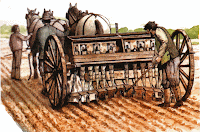
- Use of seed drills and horse-drawn harvesters

- Selective seeding
- Selective breeding of livestock
- Use of chemical fertilizers
-
Changes in the system of land ownership
- Enclosure Acts were announced
- Converted large fields shared by the community into private property
- Landowners were required to fence or enclose the land
- As poor peasants didn't have money to build fences, they had to sell the land
- Sold to aristocrats, the bourgeoisie, and rich peasants
- Many became wage workers or emigrated to cities in search of industrial jobs
- Converted large fields shared by the community into private property
- Enclosure Acts were announced


- Consequences of the Agricultural Revolution
- Increase in agricultural production
- Improvement in nutrition
- Concentration of land ownership
- Reduction in the number of peasants
- Increase in agricultural income
- Led to improved agricultural developments
- Investments in other areas like industry
Demographic Revolution
The European and British population grew in the 18th century for various causes.
- Decrease in mortality
- Improved nutrition
- Decline in major epidemics
- Improvements in urban hygiene
- Improvements in medicine
- High birth rates
- Led to a large natural population growth
This led to an increase in the workforce and a higher demand for products:
- Led to more agricultural and industrial innovations
- More emigration to other continents
Other Contributing Factors
- Modernisation of transport and transport networks
- Domestic trade
- Improvement in road surfaces
- Construction of canals
- Foreign trade
- British colonial domination
- Capital
- Raw materials
- Markets
- British colonial domination
- Domestic trade
- Growth of financial means
- Profits from commerce and land were used to finance industry
- The number of banks increased
- Availability of energy sources and raw materials
- Energy resources
- Coal (invention and development of the steam engine)
- Coal (invention and development of the steam engine)
- Natural resources
- Cotton
- Iron
- Energy resources