
Giardia duodenalis: Classification, Morphology, and History
Classified in Biology
Written on in  English with a size of 3.23 KB
Introduction to Giardia duodenalis
- Giardia duodenalis is also known as Giardia lamblia and Giardia intestinalis.
- It is a flagellated unicellular eukaryotic microorganism that colonizes and reproduces in the small intestine.
- It commonly causes a gastrointestinal condition known as Giardiasis.
Unrelated Content Block
Chinese Biotech Firm Has Been Harvesting Genomic Data On Million of Pregnant Women
Classification of Giardia duodenalis
- There are five species of Giardia, of which G. intestinalis infects humans and other mammals.
- G. duodenalis can further be differentiated into seven genotypes (A to G), of which genotypes A and B usually infect humans.
History and Global Distribution of Giardiasis
- It is one of the earliest protozoan parasites to have been recorded.
- It was first observed by Dutch scientist Antonie van Leeuwenhoek (1681) in his own diarrheal stools.
- It is named Giardia after Professor Giard of Paris and lamblia after Professor Lambie of Prague, who gave a detailed description of the parasite.
- Initially thought to be commensal, it has been recognized as a pathogen since the mid-1900s.
- It is the most common protozoan pathogen causing both endemic and epidemic intestinal disease and diarrhea, and is worldwide in distribution.
- Its prevalence is high in people with low socio-economic status and poor living conditions, as well as people in overcrowded areas with poor environmental sanitation, improper garbage disposal, unsafe water supply, and unhygienic personal habits.
Habitat of Giardia duodenalis
- Giardia duodenalis lives in the duodenum and upper jejunum.
- It is the only protozoan parasite found in the lumen of the human small intestine.
Morphology of Giardia duodenalis
Giardia duodenalis exists in two forms: Trophozoite (or vegetative form) and Cyst (or cystic form).
1. Trophozoite (Vegetative Form)
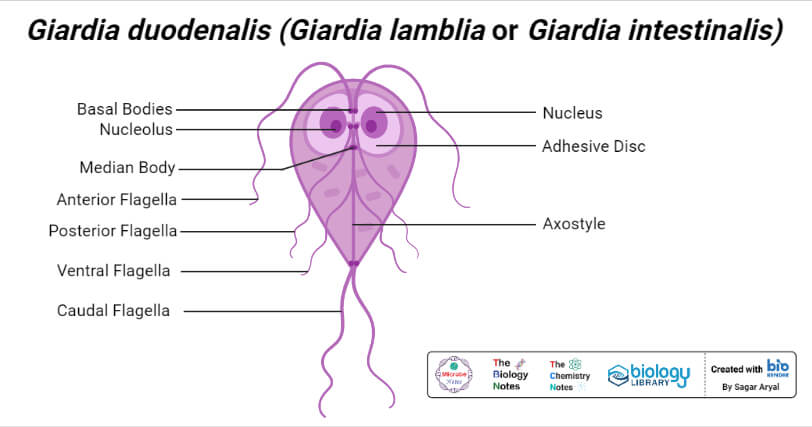
- The trophozoite is in the shape of a tennis racket (heart-shaped or pyriform-shaped).
- It is rounded anteriorly and pointed posteriorly.
- It has falling leaf-like motility and measures 12–15 µm in length and 4 µm thick.
- It is dorsoventrally convex, and ventrally, it has a concave sucking disk, which helps in its attachment to the intestinal mucosa. Hence, it appears sickle-shaped in lateral view.
- It is bilaterally symmetrical on each side from the midline and it possesses:
- One pair of nuclei
- Four pairs of flagella (two lateral, one ventral, and one caudal pair of flagella)
- Blepharoplast, from which the flagella arise (four pairs).
- One pair of axostyles, running along the midline.
- Two sausage-shaped parabasal or median bodies, lying transversely posterior to the sucking disk.
- It lives in the duodenum.