
Fundamentals of Electromagnetics and Field Theory
Classified in Physics
Written on in  English with a size of 3.63 KB
Electromagnetics Fundamentals
Electromagnetics is the study of electric and magnetic phenomena and their engineering applications.
Fundamental Forces
The four fundamental forces of nature are the nuclear, weak-interaction, electromagnetic, and gravitational force.
Electric Charge Concepts
One coulomb: amount of charge accumulated in one second by a current of one ampere.
1 coulomb represents the charge on ~ 6.241 x 10¹⁸ electrons.
Coulomb's Law
The force exerted by one point charge on another acts along the line joining the charges. It varies inversely as the square of the distance separating the charges and is proportional to the product of the charges. The force is repulsive if the charges have the same sign and attractive if the charges have opposite signs.
Branches of Electromagnetics
Electromagnetics consists of three branches:
- Electrostatics, which pertains to stationary charges.
- Magnetostatics, which pertains to DC currents.
- Electrodynamics, which pertains to time-varying currents.
Wave Characteristics
A traveling wave is characterized by a spatial wavelength ($\lambda$), a time period T, and a phase velocity.
An electromagnetic (EM) wave consists of oscillating electric and magnetic field intensities and travels in free space at the velocity of light c. The EM spectrum encompasses gamma rays, X-rays, visible light, infrared waves, and radio waves.
Static vs. Dynamic Conditions
Static conditions: charges are stationary or moving, but if moving, they do so at a constant velocity. Under static conditions, electric and magnetic fields are independent, but under dynamic conditions, they become coupled.
Transient waves: caused by sudden disturbance. Continuous periodic waves: repetitive source.
Dispersion
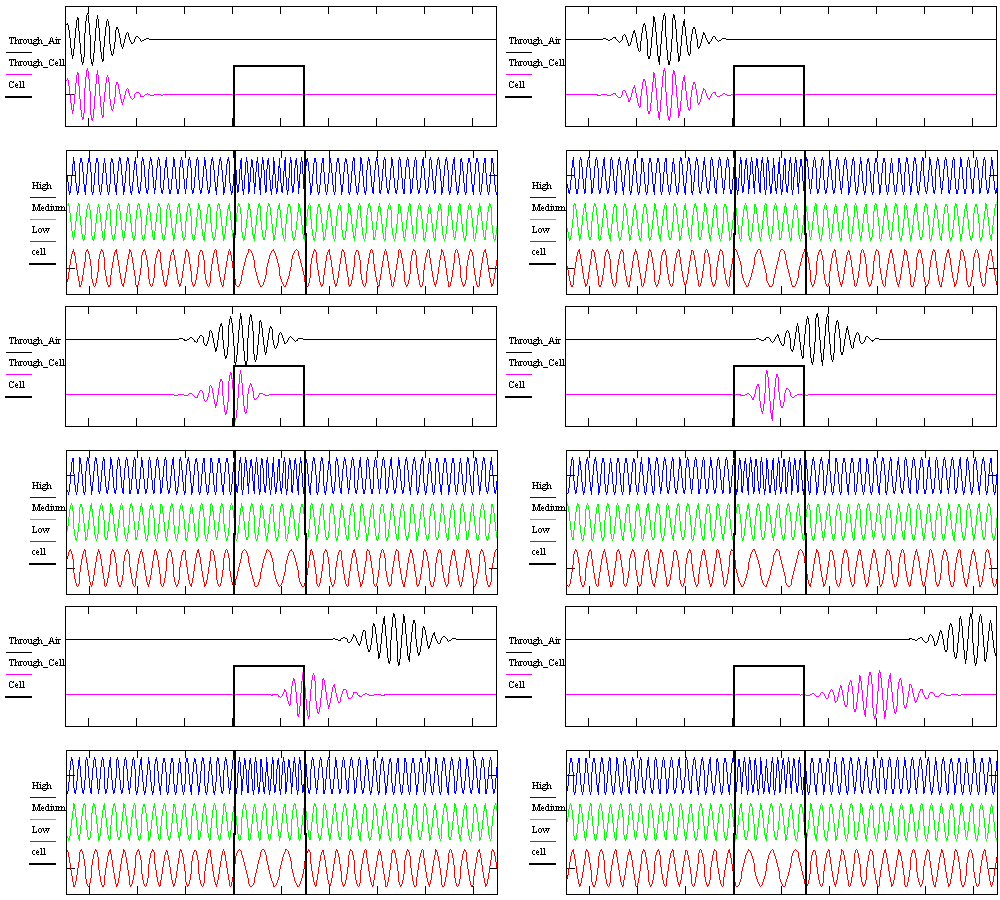
Dispersion occurs when the wave velocity depends on frequency.
Material Properties and Field Coupling
Permeability vs. Permittivity
What is the permeability of a material and what is the difference with the material’s permittivity?
Answer: Permeability: is a measure of the magnetic response of materials; permittivity: is a measure of the electric response of materials.
Field Coupling Condition
What is the condition under which electric and magnetic fields become coupled (i.e., one cannot exist without the other)?
Answer: Dynamic conditions, i.e., when either current, electric field, or magnetic field changes with time.
Wave Visualization Exercises
- Sketch out the spatial dependence of a lossy wave.
- Sketch out the time dependence of two waves: a lossless reference wave and a lossy wave that lags the reference wave.
Phasor Analysis Limitations
Can you use phasor domain equations to calculate situations involving signals at more than one frequency? Explain. What do you do in this situation to be able to solve the problem?
Answer: No, because you are explicitly removing the time dependence from the wave forms; this dependence must be the same for all the terms of the problem. If this occurs, you solve the problem for each frequency separately and convert back to time domain prior to combining the signals.
Phasor Utility
Phasor analysis is a useful mathematical tool for solving problems involving time-periodic sources.