Comprehensive C++ Programming and Data Structures Reference
Classified in Computers
Written on in  English with a size of 8.72 KB
C++ Fundamentals
Let's learn about basic C++
Source: GeeksforGeeks
Loops in C++
For Loop
#include <iostream>
using namespace std;
int main() {
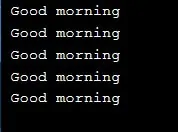
    for(int i = 1; i <= 5; i++) {
        cout << "Good morning \n";
    }
    return 0;
}
While Loop
#include <iostream>
using namespace std;
int main() {
    int i = 0; // Initialization
    while(i < 5) { // Test expression
        cout << "Good morning\n";
        i++; // Update expression
    }
    return 0;
}
Do-While Loop
#include <iostream>
using namespace std;
int main() {
    int i = 2; // Initialization
    do {
        cout << "Good morning\n";
        i++; // Update expression
    } while(i < 1); // Test expression
    return 0;
}
C++ Interview Questions
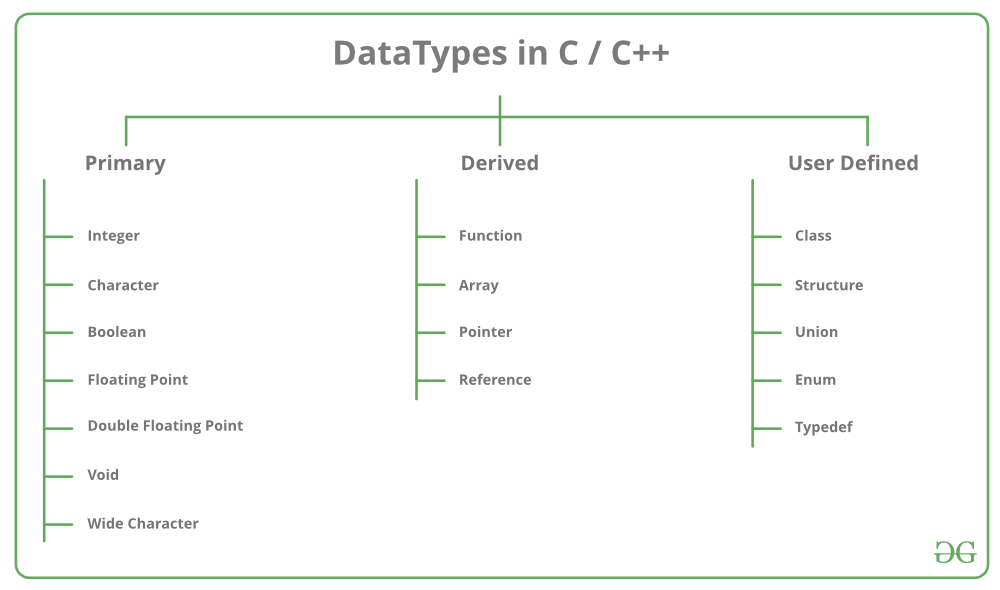
1. Data Types in C++
The 4 data types in C++ are:
- Primitive: char, short, int, float, long, double, bool, etc.
- Derived: array, pointer, etc.
- Enumeration: enum
- User-defined: structure, class, etc.
2. Difference Between C and C++
| C | C++ |
|---|---|
| Procedure-oriented. | Object-oriented. |
| No data hiding. | Encapsulation for data hiding. |
| Subset of C++. | Superset of C. |
| No overloading. | Supports function/operator overloading. |
| No namespaces. | Uses namespaces. |
| Functions cannot be in structs. | Functions can be in structs. |
| malloc()/free(). | new/delete operators. |
3. Class and Object
A class is a user-defined data type containing data members and member functions. An object is an instance of a class.
class A {
private:
    int data;
public:
    void fun() {}
};
4. Struct vs. Class
| Structure | Class |
|---|---|
| Members are public by default. | Members are private by default. |
| Default inheritance is public. | Default inheritance is private. |
5. Operator Overloading
Allows redefining operators (+, -, *, etc.) for user-defined types.
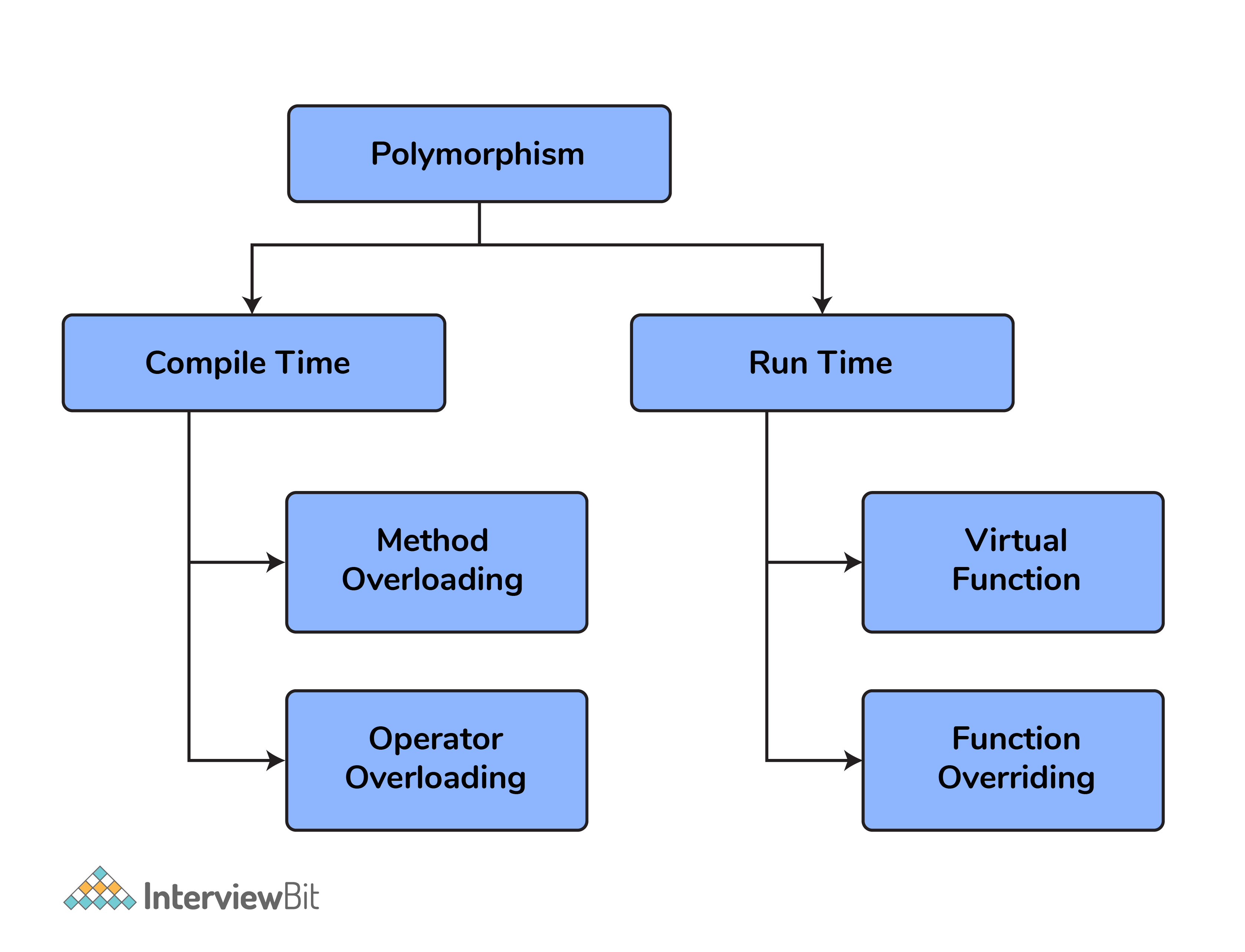
6. Polymorphism
Means "many forms." Types: Compile-time (overloading) and Runtime (virtual functions).
7. Constructors
Member functions executed automatically upon object creation. Same name as the class, no return type.
8. Virtual Functions
Member functions in a base class redefined in a derived class, enabling runtime polymorphism.
9. Compile-time vs. Runtime Polymorphism
| Compile-time | Runtime |
|---|---|
| Resolved by compiler. | Resolved at runtime. |
| Faster execution. | Slower execution. |
| Overloading. | Virtual functions. |
10. Friend Class and Function
Can access private and protected members of a class without being a member function.
11. Access Specifiers
- Public: Accessible everywhere.
- Protected: Accessible in class and derived classes.
- Private: Accessible only within the class.
12. Inline Functions
Compiler replaces the function call with the function body to reduce overhead.
13. References
An alias for an existing variable.
14. Abstraction
Hiding complex implementation details and showing only essential features.
15. Destructor Overloading
Not possible, as destructors take no arguments.
16. Call by Value vs. Reference
Value passes a copy; Reference passes the address.
17. Abstract Class
A class with at least one pure virtual function; cannot be instantiated.
18. Destructors
Called automatically when an object is destroyed. Same name as class, preceded by a tilde (~).
19. Static Members
Shared across all instances of a class; only one copy exists.
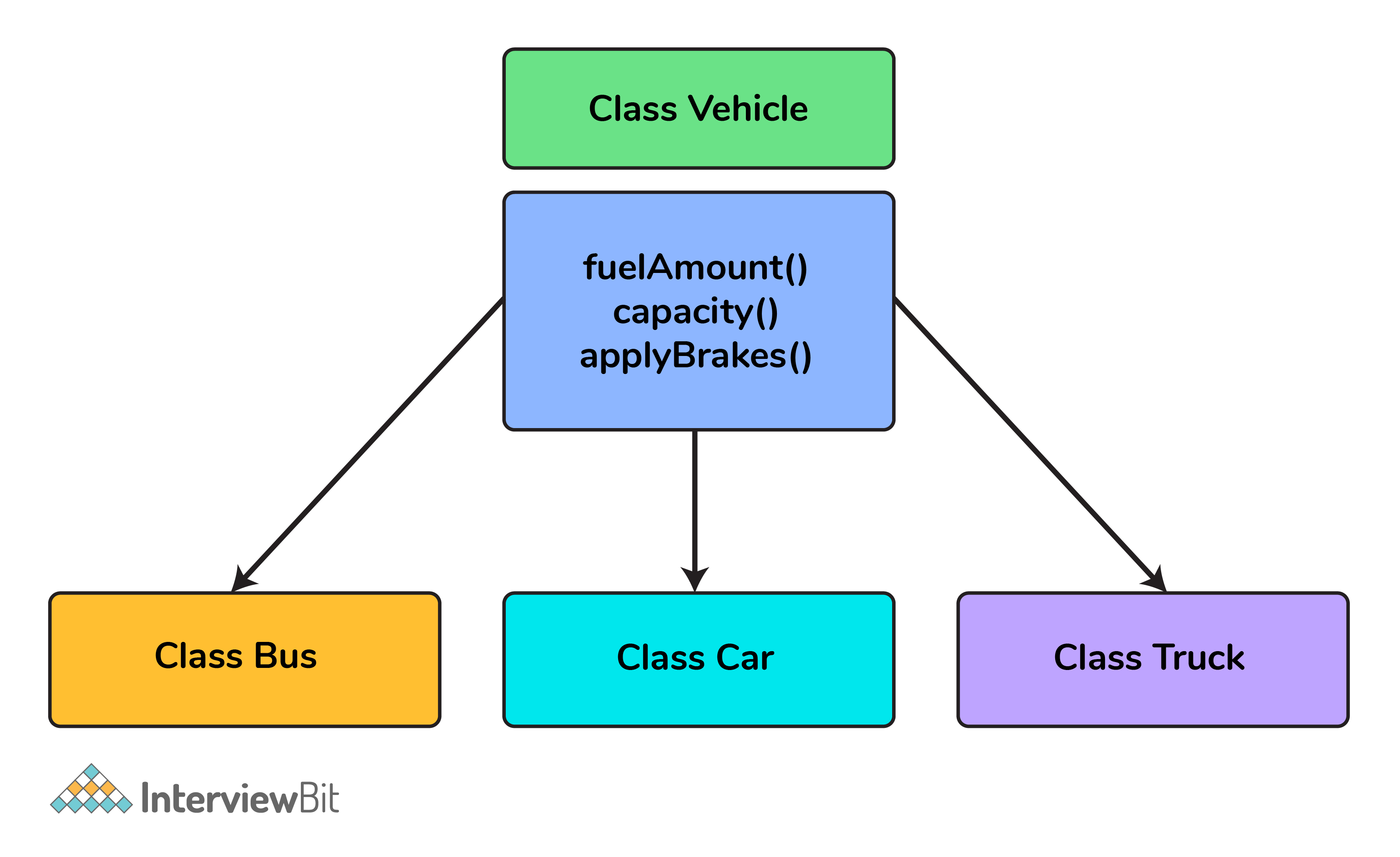
20. Inheritance
Creating new classes from existing ones to enable code reusability.
Experienced Interview Questions
21. Copy Constructor
Initializes an object using another object of the same class.
22. Shallow vs. Deep Copy
Shallow copies references; Deep copies the actual data.
23. Virtual vs. Pure Virtual Functions
Pure virtual functions (= 0) have no implementation in the base class.
24. Constructor/Destructor Order
Constructors: Base to Derived. Destructors: Derived to Base.
25. Virtual Functions in Constructors
Possible, but they do not exhibit polymorphic behavior within the constructor.
26. Void Pointers
Generic pointers that can hold addresses of any data type.
27. This Pointer
A pointer to the current object instance.
28. Memory Management
Use new for allocation and delete for deallocation.
Data Structures and Algorithms


1.2 Vector
Use for simple storage and quick index lookups.
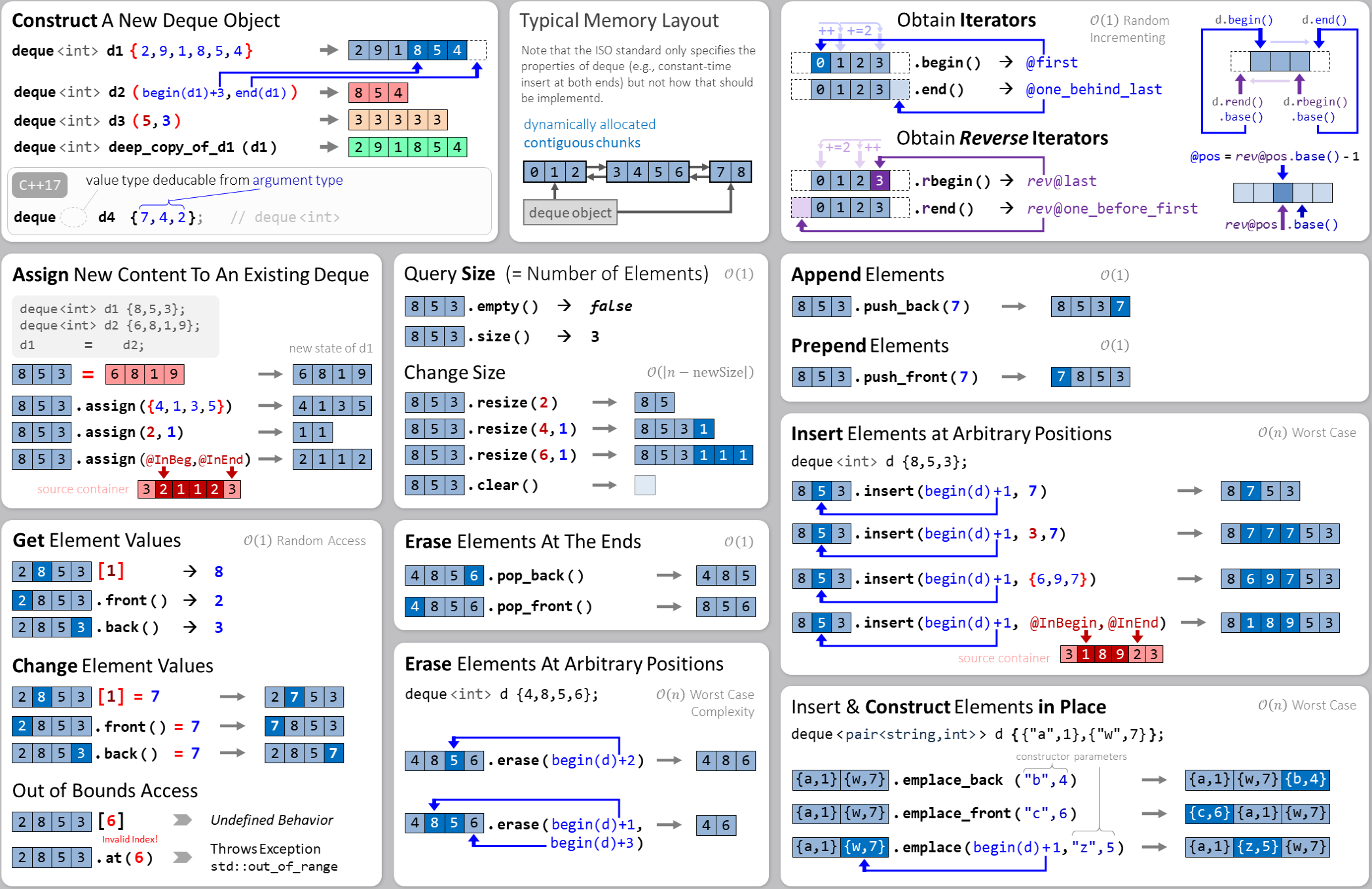
1.3 Deque
Double-ended queue; efficient front/back operations.
1.4 List
Efficient insertion/deletion in the middle.
1.5 Map
Key-value pairs; std::map (ordered) vs std::unordered_map (hash table).
1.6 Set
Stores unique elements; ordered.
1.7 Stack
LIFO (Last-In, First-Out).
1.8 Queue
FIFO (First-In, First-Out).
1.9 Priority Queue
Elements ordered by priority.
1.10 Heap
Min/Max heap implementation using priority queues.
Trees and Searching
2.1 Binary Tree
At most two children per node.
2.2 Balanced Trees
AVL or Red-Black trees to maintain O(log n) operations.
2.3 Binary Search
O(log n) search on sorted data.
2.4 Depth-First Search (DFS)
Recursively explore branches.

2.5 Breadth-First Search (BFS)
Explore level by level.

Algorithms
4.1 Insertion Sort
Simple, efficient for small datasets.
4.2 Selection Sort
In-place sorting.

4.3 Bubble Sort
Inefficient for large datasets.
4.4 Merge Sort
Divide and conquer; O(n log n).
4.5 Quicksort
Fast, divide and conquer; O(n log n) average.
General Interview Tips
Prepare for behavioral questions like "Tell me about yourself," "Why this company?," and "How do you handle pressure?" Always have questions ready for the interviewer.