
Notes, summaries, assignments, exams, and exercises for Mathematics for Secondary education

Sort by
Subject
Level

Mathematics Cheat Sheet: Essential Rules, Formulas, and Examples

Posted by Anonymous and classified in Mathematics

Written on in English with a size of 195.44 KB

Mathematics Term 3 Reference

Chapter 2

Divisibility Tests

  • 1: All numbers are divisible by 1.
  • 2: All even numbers are divisible by 2. Last digit must be 0, 2, 4, 6, or 8.
  • 3: The sum of the digits must be divisible by 3.
  • 4: The number formed from the last two digits must be divisible by 4.
  • 5: The last digit must be 0 or 5.
  • 6: Must pass the divisibility tests for both 2 and 3.
  • 7: (There is no simple test for divisibility by 7).
  • 8: The number formed from the last three digits must be divisible by 8.
  • 9: The sum of the digits must be divisible by 9.
  • 10: The last digit must be 0.

Terms for Division

  • Dividend: The starting number; the total; the amount you have.
  • Divisor: The number doing the dividing; the number of groups.
  • Quotient: The number of times the divisor
... Continue reading "Mathematics Cheat Sheet: Essential Rules, Formulas, and Examples" »

Grade 9 Math Final Exam Review: Rational Numbers and Exponents

Posted by Anonymous and classified in Mathematics

Written on in English with a size of 1.99 KB

Grade 9 Math Final Review

Rational Numbers

A rational number is any positive or negative number that can be written as a fraction. Terminating and repeating decimals are always rational because they can be expressed as fractions.

  • Adding and Subtracting: Find a common denominator. (e.g., 2/4 + 3/8 = 4/8 + 3/8 = 7/8)
  • Multiplying: Reduce before multiplying if possible. (e.g., 11/8 * 6/22 = 1/4 * 3/2 = 3/8)
  • Dividing: Use the Keep, Change, Flip method. Keep the first fraction, change division to multiplication, and flip the second fraction.

Converting Between Forms

  • Decimal to Fraction: Write the decimal over 1. Count the digits after the decimal and multiply the numerator and denominator by the corresponding power of 10 (e.g., 100 for two digits). Simplify
... Continue reading "Grade 9 Math Final Exam Review: Rational Numbers and Exponents" »

Financial Mathematics: Interest and Loan Calculation Steps

Posted by Anonymous and classified in Mathematics

Written on in English with a size of 2.82 KB

1. Emilie's 3-Year Payment Plan

Answer: 12.4%

Formula: Interest = P × r × t

  • Total payment: 36 months × $33.70 = $1,213.20
  • Total interest paid: $1,213.20 - $884.92 = $328.28
  • Rate calculation: $328.28 = $884.92 × r × 3; r = 0.1236 or 12.4%

2. 312 Sq Ft Family Room Flooring

Answer: 22.7%

  • Total cost: $1.37 × 312 = $427.44
  • Tax amount: $427.44 × 0.068 = $29.07
  • Total purchase: $427.44 + $29.07 = $456.51
  • Total repayment: 24 × $27.66 = $663.84
  • Total interest: $663.84 - $456.51 = $207.33
  • Interest rate: $207.33 / ($456.51 × 2) = 0.227 or 22.7%

3. Sea Drift Motel Loan

Answer: 0.44%

Using the simple interest formula I = P × r × t:

  • Interest (I): $97,000
  • Principal (P): $1,000,000
  • Time (t): 22 years
  • Rate (r): 0.0044 or 0.44%

4. Effective Interest Rate Calculation

Using... Continue reading "Financial Mathematics: Interest and Loan Calculation Steps" »

Mastering Linear Systems and Quadratic Functions

Posted by Wikiteka Community and classified in Mathematics

Written on in English with a size of 135.59 KB

Finding the Point of Intersection

Method 1: Elimination

  1. Use multiplication to get one variable having the same numbers in both equations (they can have different signs).
  2. If the signs for the variables are the same, subtract the two equations; otherwise, add them.
  3. Substitute the answer into an original equation and solve.

Method 2: Substitution

  1. Isolate one variable in one equation.
  2. Substitute into the other equation.
  3. Solve.
  4. Substitute the answer into the original and solve.

Triangle Centers and Properties

Finding the Median

  1. Determine the midpoint of the opposite line using the midpoint formula.
  2. You now have two points; determine the slope of the median.
  3. Use the slope and one point to determine the equation of the median.

Finding the Altitude

  1. Determine the slope
... Continue reading "Mastering Linear Systems and Quadratic Functions" »

Accounting Fundamentals: Journal, Ledger, Trial Balance, Bills & Notes

Posted by Wikiteka Community and classified in Mathematics

Written on in English with a size of 4.62 KB

Journal Entries: Recording Business Transactions

Format of Journal Entries

DateParticularsDebit (₹)Credit (₹)
YYYY-MM-DDDebit Account (Dr)Amount
To Credit Account (Cr)Amount
(Brief description/Narration)

Examples of Journal Entries

  1. Started Business with Cash ₹1,00,000

    • Cash A/c Dr ₹1,00,000
      To Capital A/c ₹1,00,000
    • (Being business started with cash)
  2. Purchased Goods for Cash ₹20,000

    • Purchases A/c Dr ₹20,000
      To Cash A/c ₹20,000
    • (Being goods purchased for cash)
  3. Sold Goods to Priya for ₹10,000 on Credit

    • Priya A/c Dr ₹10,000
      To Sales A/c ₹10,000
    • (Being goods sold to Priya on credit)
  4. Paid Rent ₹5,000

    • Rent A/c Dr ₹5,000
      To Cash A/c ₹5,000
    • (Being rent paid in cash)

Ledger Posting: Classifying Transactions

Format of Ledger Accounts

ParticularsJ.F.
... Continue reading "Accounting Fundamentals: Journal, Ledger, Trial Balance, Bills & Notes" »

TDS Return Due Dates and PAN vs TAN Comparison

Posted by Anonymous and classified in Mathematics

Written on in English with a size of 4 KB

TDS Return Filing Due Dates

A Tax Deducted at Source (TDS) return is a quarterly statement submitted to the Income Tax Department. It is mandatory for deductors to submit these returns on time to avoid late fees, which accrue at ₹200 per day under Section 234E.

The financial year is divided into four quarters. The due date is generally the last day of the month following the end of the quarter, with an exception for the final quarter.

QuarterPeriodDue Date for Filing TDS Return
Quarter 1 (Q1)April 1 – June 30July 31
Quarter 2 (Q2)July 1 – September 30October 31
Quarter 3 (Q3)October 1 – December 31January 31
Quarter 4 (Q4)January 1 – March 31May 31 (Extra month for year-end closing)

Differences Between PAN and TAN

While both are unique 10-... Continue reading "TDS Return Due Dates and PAN vs TAN Comparison" »

Algebra and Trigonometry Practice Problem Solutions

Posted by Anonymous and classified in Mathematics

Written on in English with a size of 7.68 KB

Algebra and Trigonometry Problem Set

  1. y = -6x3 + 4x2 - x + 2
  2. Vertical shrink by 1/2, horizontal translation 2 to the left, vertical translation 1 down
  3. 4x4 - 11x3 + 7x2 + 5x - 3
  4. $713,476.20
  5. Brian is designing a handrail for a staircase and needs to determine the length: 12
  6. A meteorologist predicts a 42% chance of rain on Saturday and a 54% chance of rain on Sunday: 27%
  7. an = 3n - 11
  8. (-2, 6) lies on the terminal side of an angle θ in standard position: Sinθ = 3√10 is False, True, True
  9. y = log(x - 2)
  10. Find the sum of the series: 12
  11. The table shows enrollment by gender as an undergraduate or graduate student: 515/2463 = 0.209

Zeros of Functions

12. Find the zeros of the function shown below:
f(x) = x2 + 3x - 10: x = 2 and -5

Statistical Distributions

13. Normal... Continue reading "Algebra and Trigonometry Practice Problem Solutions" »

Machine Learning Model Performance: Boosting, Evaluation, and Validation

Posted by Anonymous and classified in Mathematics

Written on in English with a size of 12.88 KB

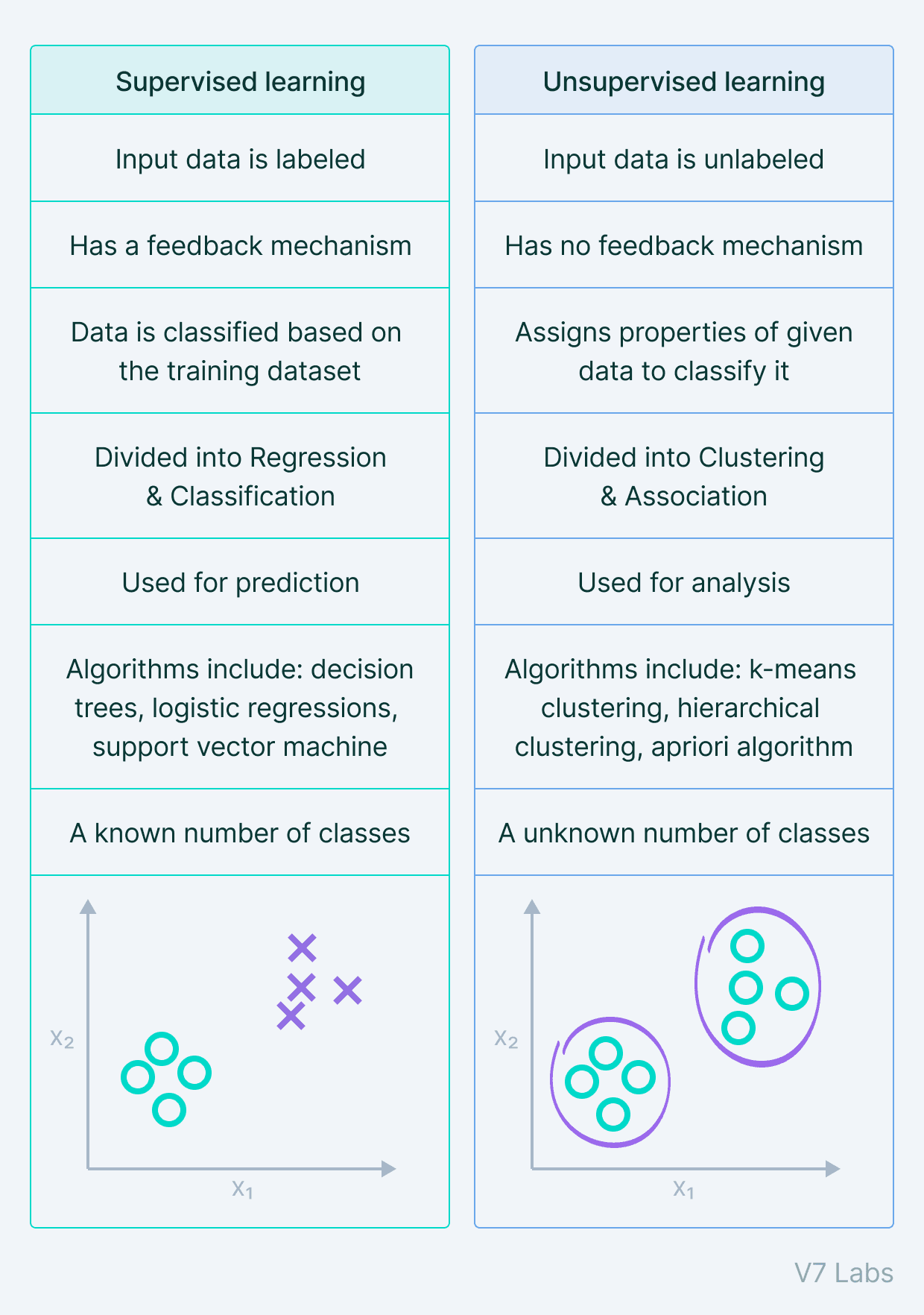
Supervised vs Unsupervised learning


AdaBoost: Adaptive Boosting Algorithm Explained

AdaBoost (Adaptive Boosting) is a classic and widely used boosting algorithm that focuses on correcting the errors of preceding weak learners (typically decision trees). It works by iteratively adjusting the weights of the training data points.

How AdaBoost Works

  1. Initial Weights: AdaBoost starts by assigning equal weights to all the training data points.
  2. Train a Weak Learner: A "weak" learner (a model that performs slightly better than random chance, like a decision stump) is trained on the dataset using the current weights.
  3. Calculate Error and Performance: The error rate of the weak learner is calculated based on the instances it misclassified. A measure of the weak learner's performance (often called
... Continue reading "Machine Learning Model Performance: Boosting, Evaluation, and Validation" »

Year 9 Algebra Essentials: Linear Equations Mastery

Posted by Anonymous and classified in Mathematics

Written on in English with a size of 3.63 KB


1. Simplifying Algebraic Expressions

How to Simplify Algebraic Expressions

  • Multiply numbers and letters together.
  • Combine like terms (terms with the same letters and powers).

Example:
−2ac × 4bd = −8abcd

Example:
5ab − 8b²a + ba = 5ab − 8ab² + ab = −8ab² + 6ab


2. Expanding Brackets (Distributive Law)

How to Expand Brackets

  • Multiply everything inside the bracket by what is outside.

Example:
−4(x + 7) = −4x − 28

Example:
5(x − 3) + 2(6 − x) = 5x − 15 + 12 − 2x = 3x − 3


3. Solving Equations

How to Solve Equations

  • Get all variables (e.g., x's) on one side and numbers on the other.
  • Perform the same operation on both sides of the equation.

Example:
3x + 2 = 17
3x = 15
x = 5

Example:
9x − 8 = 4x + 7
5x = 15
x = 3


4. Solving Inequalities

How

... Continue reading "Year 9 Algebra Essentials: Linear Equations Mastery" »

Key Financial Ratios for Business Performance

Posted by Wikiteka Community and classified in Mathematics

Written on in English with a size of 3.61 KB

Current Ratio

The current ratio measures a company's ability to pay short-term obligations with its current assets.

  • Positive (>1): Current assets can meet current liabilities. Specifically, assets cover [X]% of the liabilities.
  • Negative (<1): Current assets cannot meet all current liabilities. They only cover [X]%, indicating a risk of short-term default.

Acid Test (Quick Ratio)

This metric determines if a company can meet its short-term debts without relying on inventory sales.

  • Positive (0.8–1.2): With bank cash and accounts receivable, the company can satisfy [X]% of current liabilities without selling stock.
  • Negative (<0.8): The company can only satisfy [X]% of liabilities without stock, making it too dependent on inventory sales to
... Continue reading "Key Financial Ratios for Business Performance" »