Notes, summaries, assignments, exams, and exercises for Biology for Secondary education

The Process of Photosynthesis: From Sunlight to Sugar

Biology3.8 KB

The Role of Autotrophs

Autotrophs are crucial because they create their own food from sunlight through a process called photosynthesis. They form the base of all food chains by producing energy-rich compounds, such as glucose, and releasing oxygen, which is essential for other organisms to survive.

Chloroplast Structure

A chloroplast is enclosed by two outer membranes. Its interior contains a fluid-filled space called the stroma, where the Calvin Cycle occurs. Within the stroma are stacks of flat, disc-like structures called thylakoids. Each stack is known as a granum (plural: grana). The thylakoid membranes contain chlorophyll, the site of the light-dependent reactions.

Function of Chlorophyll

Chlorophyll is the green pigment found in chloroplasts....

Continue reading "The Process of Photosynthesis: From Sunlight to Sugar" »

Human Body Systems and Digestive Anatomy

Biology3.64 KB

Vital Human Body Systems

The human body relies on several key systems to function effectively:

  • Respiratory System: Obtains oxygen for cells and expels CO2.
  • Digestive System: Allows food to enter the body, breaking it down into nutrients.
  • Excretory System: Removes waste products from the body.
  • Circulatory System: Transports nutrients and oxygen to the cells and removes waste.

The Digestive System and Tract

The digestive system allows food to enter the body and converts it into nutrients, which are then absorbed into the blood. The digestive tract is a tube eight meters long. It has an inner layer of cells called the mucosa. Layers of muscle surround this tube; when these layers contract, they push food down.

The Mouth and Dental Structure

In the mouth,...

Continue reading "Human Body Systems and Digestive Anatomy" »

Essential Functions of Human Body Systems and Coordination

Biology7.42 KB

Skeletal System: Functions and Joints

Skeletal System Functions

  • Support the body structure.
  • Protect vital organs.
  • Provide points of attachment for muscles.
  • Manufacture blood cells (hematopoiesis).
  • Store calcium and phosphorus.

Joints: Connections Between Bones

Joints are places where bones connect. They are classified by the degree of movement they permit:

  • Fixed Joints (Synarthroses): Do not permit movement (e.g., skull sutures).
  • Slightly Movable Joints (Amphiarthroses): Allow limited movement (e.g., vertebrae).
  • Freely Movable Joints (Diarthroses): Allow bone movement in all directions (e.g., knee).

Sensory Receptors and Stimuli Perception

Types of Receptors

  • Internal Receptors (Interoceptors): Perceive changes occurring inside the body (e.g., blood pressure,
...
Continue reading "Essential Functions of Human Body Systems and Coordination" »

Life Processes: Nutrition, Respiration, Transportation & Excretion

Biology5.14 KB

Chapter 5: Life Processes

Introduction

Life processes are the basic functions performed by living organisms for survival and body maintenance. These include nutrition, respiration, transportation, and excretion.

Nutrition

There are two modes of nutrition: autotrophic and heterotrophic.

Autotrophic Nutrition (Photosynthesis)

Photosynthesis is the process by which green plants synthesize their own food using carbon dioxide (CO2) and water (H2O) in the presence of chlorophyll and sunlight.

Raw Materials for Photosynthesis: Carbon dioxide and water.

Site of Photosynthesis: Chloroplasts in the leaves. Chloroplasts contain a green pigment called chlorophyll.

Main Events of Photosynthesis:

  • Absorption of light energy by chlorophyll.
  • Conversion of light energy
...
Continue reading "Life Processes: Nutrition, Respiration, Transportation & Excretion" »

Cellular Energy: Photosynthesis and Respiration

Biology4.63 KB

Photosynthesis and Cellular Respiration

Photosynthesis

Photosynthesis is the process by which plants convert carbon dioxide and water into glucose and oxygen, using light energy. This endothermic reaction can be summarized by the following equation:

6CO2 + 6H2O -> C6H12O6 + 6O2

The rate of photosynthesis is influenced by several factors, often referred to as limiting factors. These include:

  • Light intensity: Increased light levels generally lead to a higher rate of photosynthesis until an optimum level is reached.
  • Carbon dioxide concentration: Higher levels of carbon dioxide can enhance the rate of photosynthesis, up to a certain point.
  • Temperature: Plants in their ideal temperature range perform photosynthesis more efficiently than those outside
...
Continue reading "Cellular Energy: Photosynthesis and Respiration" »

Anatomical Directions, Planes and Major Body Cavities

Biology3.5 KB

Muscular Origins & Insertions (Quick Study Academic): BarCharts, Inc.:  9781572227545: Amazon.com: Books

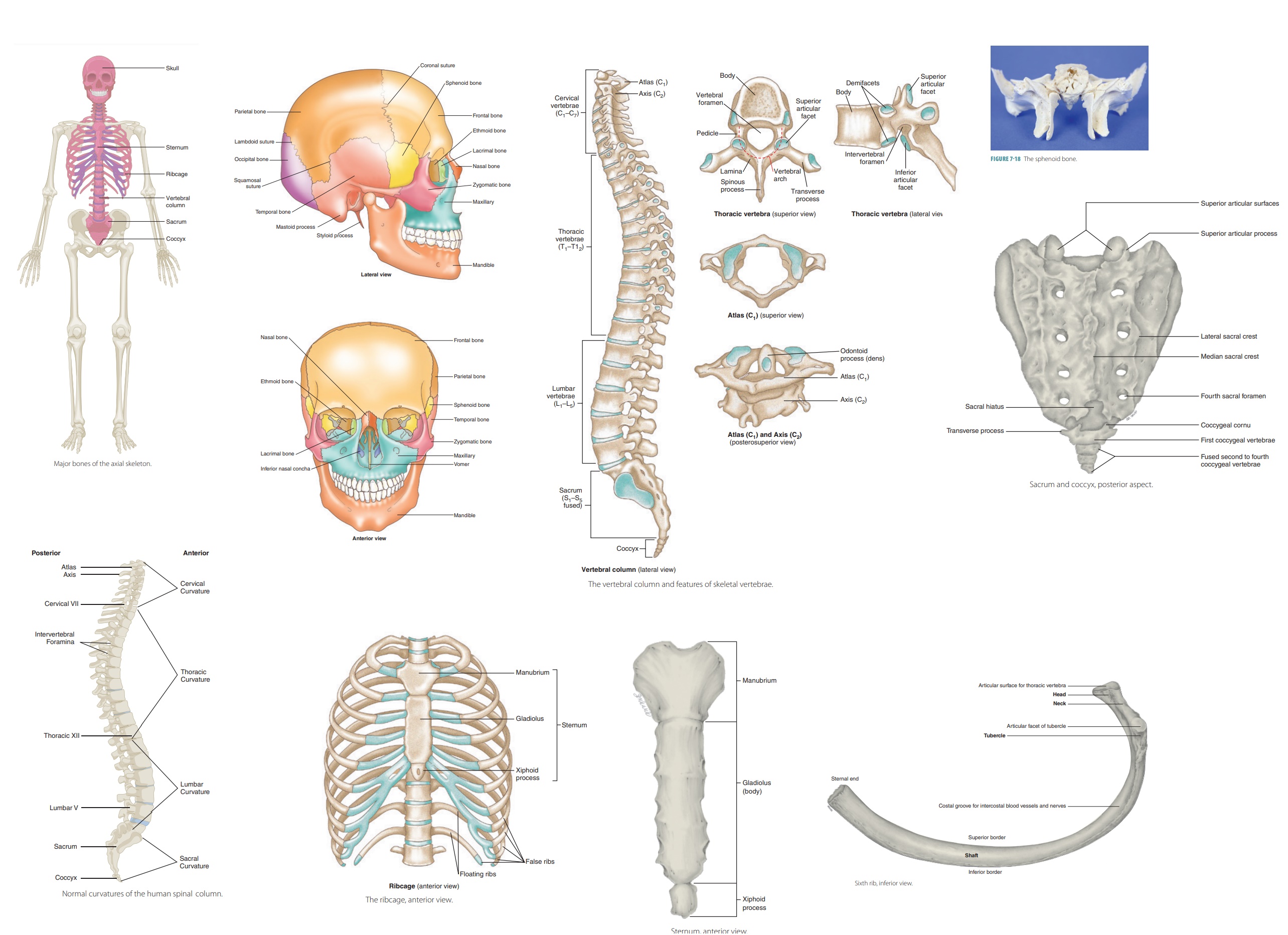
Axial Skeleton - Skeletal Organization 13 Biomechanics of Joints | Musculoskeletal Key

Anatomical Directions and Terms

  • Anterior (ventral): Toward the front of the body.
  • Posterior (dorsal): Toward the back of the body.
  • Superior: A part above another part.
  • Inferior: A part below another part.
  • Medial: Toward the midline (median plane) of the body.
  • Lateral: Away from the midline of the body; toward the sides.
  • Proximal: Toward the point of attachment to the body.
  • Distal: Away from the point of attachment to the body.
  • Deep: Toward the inside of the body.
  • Superficial: Toward the outside of the body.
  • Parietal: A membrane that covers an internal body wall.
  • Visceral: A membrane that covers an organ.

Body Planes

Sagittal: The plane that runs down through the body, dividing it into left and right portions. Subsections of the sagittal plane include:

...

Continue reading "Anatomical Directions, Planes and Major Body Cavities" »

Human Body Systems: Digestion, Respiration, and Excretion

Biology3.58 KB

The Human Digestive System: Function and Components

The digestive system transforms food into nutrients, which are then transported by the circulatory system through the blood to the cells. It is a set of organs and structures, including the digestive tract and accessory glands.

Key Components of the Digestive System

  • Mouth
  • Pharynx
  • Oesophagus
  • Stomach
  • Small Intestine
  • Large Intestine
  • Appendix
  • Salivary Glands
  • Liver
  • Pancreas

Initial Digestion: Mechanical and Chemical Processes

Digestion is the transformation of food into nutrients so that cells can benefit from them. It can be mechanical or chemical. Digestion begins in the mouth immediately after food is ingested.

Processes and Elements in Oral Digestion

  • Mastication (Chewing)
  • Food
  • Tongue
  • Salivary Glands
  • Bolus formation
...
Continue reading "Human Body Systems: Digestion, Respiration, and Excretion" »

Key Differences Between Living and Non-Living Things

Biology3.62 KB

Living vs. Non-Living Things

Both living and non-living things are made up of matter. All living things share certain common characteristics. These characteristics can help us identify a mineral as a non-living thing and a butterfly as a living one.

Composition of Non-Living Things

Non-living things are made up of inorganic matter. The most abundant chemical elements include:

  • Oxygen
  • Silicon
  • Aluminum
  • Iron

Composition of Living Things

Living things are made up of chemical elements called bioelements. The most abundant are:

  • Oxygen
  • Nitrogen
  • Phosphorus
  • Sulfur

Key Characteristics of Life

Nutrition

Autotrophic Nutrition

Organisms with autotrophic nutrition capture energy from their environment and use it to transform inorganic substances, such as water, carbon dioxide,...

Continue reading "Key Differences Between Living and Non-Living Things" »

Human Reproduction: Processes, Characteristics, and Anatomy

Biology3.17 KB

Human Reproduction: Fundamental Processes

Human reproduction is sexual, meaning that both the mother and father contribute genetic material to their offspring via gametes. Offspring will have a mix of their parents' characteristics, and each person obtains their own unique genetic make-up.

The female gametes, ovules, and the male gametes, sperm, fuse together in the process called fertilisation, inside the female reproductive system, to form a zygote.

The embryo develops from the zygote inside the mother's uterus, undergoing repeated cell divisions. The new cells created specialise to form tissues and organs.

Sexual Characteristics and Puberty

Boys and girls are born with different reproductive organs, which constitute the so-called primary sexual

...
Continue reading "Human Reproduction: Processes, Characteristics, and Anatomy" »

Sex Determination and Inheritance Patterns

Biology2.3 KB

Sex Determination Mechanisms

Haploid-Diploid Sex Determination

In this system, the total number of chromosomes in a cell determines the sex of a new individual.

X Chromosome to Autosome Ratio

Sex is determined by the ratio between the number of X chromosomes and the total number of autosomes.

Environmental Sex Determination

In this system, individuals are affected by several environmental variables after fertilization. Generally, the most influential of these is temperature. However, other factors, such as the number of hours of daylight, nutrition, humidity, and the pH of water can also affect sex determination.

Inheritance Linked to Sex

Genes found on sex chromosomes are transmitted differently in males and females because these chromosomes differ...

Continue reading "Sex Determination and Inheritance Patterns" »