
Notes, summaries, assignments, exams, and exercises for Visual arts and art education for Secondary education

Una historia en ingles simple present,simple past,future,past continuous y present continuous

Visual arts and art education1.28 KB

Past Simple: acciones pasadas.
S+V-ED+RESTO.
S+DIDN'T+FORMA BASE V+ RESTO.
DID+S+FBV+R?
WAS/WERE:
I WAS YOU WERE HE/SHE/IT WAS ...WERE.
PAST CONTINUOUS: OCURRIENDO EN EL PASADO.
S+WAS/WERE+V-ING+RESTO.
S+WASN'T/WEREN'T+V-ING+RESTO
WAS/WERE+S+V-ING+RESTO?
WILL:IF.
IF+PRESENT SIMPLE+WILL+VP.
BE GOING TO: PLANES.
S+TO BE+GOING TO+V+R
TO BE NEGADO
TO BE+S+GOING TO+V+R
PRESENT PERFECT: ACCIONES CON REPERCUSION.
S+HAVE/HAS+PARTICIPIO+R
HAVEN'T/HASN'T
HAVE/HAS+S+P+R?
MIO MINE TUYO YOURS SUYO HIS HERS ITS
NUESTRO OURS VUESTRO YOURS SUYO THEIRS
The Complete Guide to Manicures and Pedicures

Visual arts and art education9.15 KB

Manicure A/B/C

1. Julissa used the buffer (C) - an object that makes nails shiny.

2. The nail technician was careful not to cut too much of the cuticle (B) - the skin around the nail.

3. Max cleaned the dirt from his nails with a nail brush (A) - an object with stiff pieces of plastic used to clean nails.

RELLENAR

1. Kate put her hands in the finger bowl, which was full of soapy water.

2. A manicurist trims dead skin from around a client's nails with a cuticle trimmer.

3. After a long day at work, Max soaks his tired feet in warm water.

4. Penny often files the rough edges of her nails to keep them smooth.

5. Wendy showed her sister how to push back her cuticles with an orange stick.

INTERES

1. What is the purpose of the guide?: (d) to explain the steps...

Continue reading "The Complete Guide to Manicures and Pedicures" »

Understanding Triangle Centers: Circumcenter, Incenter, Centroid, and Orthocenter

Visual arts and art education3.63 KB

A polygon is the portion of the plane bounded by a closed polyline. A polygon is a plane shape with straight sides. A plane is a flat surface with no thickness.
Polygons are 2-dimensional shapes. They are made of straight lines, and the shape is “closed” (all the lines connect up).

1. Circumcenter

The circumcenter is the center of the triangle’s circumcircle, one that passes through the three vertices of the triangle.
It is located at the intersection of the three side bisectors. As we already know the line bisector is the locus of all the circle centers that pass through the endpoints of a segment. As the three sides of a triangle are segments, if we draw the three side bisectors, we will get a point that will be the center of a circle that...

Continue reading "Understanding Triangle Centers: Circumcenter, Incenter, Centroid, and Orthocenter" »

Understanding Projection Systems in Technical Drawing

Visual arts and art education2.93 KB

Projecting Points and Shapes

Projecting points onto a plane involves rays passing through the points and intersecting the plane. These intersections are called projections. Projecting a shape involves projecting its vertices.

Projection Systems

There are two main systems of projection:

Perspective Projection

When the rays originate from a single point, the system is called perspective projection. The resulting shape is proportionally smaller or larger.

Parallel Projection

When the rays are parallel, the system is called parallel projection. The resulting shape is congruent (same shape and size). There are two variations:

  1. Oblique Projection: The rays are oblique to the projection plane.

  2. Orthographic Projection: The rays are perpendicular to the projection

...
Continue reading "Understanding Projection Systems in Technical Drawing" »

Fundamentals of Color Theory: Light and Pigment Mixing

Visual arts and art education3.14 KB

1. Additive Color Mixtures (Light)

We can derive all colors from three primary colors of light: Red, Green, and Blue (RGB).

An additive mixture is created when colored lights are mixed, because we are adding light energy each time. Mixing two primary colors results in secondary colors:

  • Blue Light + Green Light = Cyan Light
  • Green Light + Red Light = Yellow Light
  • Blue Light + Red Light = Magenta Light

When combining all three primary colors of light, the result is white light.

Color Descriptions in Additive Systems

In this context, blue refers to a more blue-violet color; red is often a red-orange; magenta is similar to fuchsia pink; and cyan is a bright blue.

2. Subtractive Color Mixtures (Pigments)

Color pigments, such as the paints used on paper, are...

Continue reading "Fundamentals of Color Theory: Light and Pigment Mixing" »

English Grammar: Tenses, Passive Voice, Conditionals, and More

Visual arts and art education6.48 KB

Verb Tenses

Past Simple

Structure: Subject + Verb (past form or -ed) or 3rd column; Negative: didn't + base form.

Uses: Completed actions in the past (with expressions like last, ago, yesterday, in 1992).

Past Continuous

Structure: was/were + verb-ing.

Uses: Actions in progress in the past; Past Continuous + when + Past Simple or Past Continuous + while + Past Continuous.

Past Perfect

Structure: had + past participle (verb-ed or 3rd column).

Uses: An action that happened before another action in the past (with expressions like after, before).

Future Simple (Will)

Structure: will + base form.

Uses: Weather, promises, future predictions, spontaneous decisions.

To Be Going To

Structure: is/am/are + going to + base form.

Uses: Future plans.

Present Simple

Uses:

...
Continue reading "English Grammar: Tenses, Passive Voice, Conditionals, and More" »

Understanding Color: Rainbows, Light, Pigments, and Saturation

Visual arts and art education2.45 KB

Understanding Color: Rainbows, Light, and Pigments

A rainbow occurs when sunlight passes through raindrops, separating the light into seven colored lights.

Absorption conveys the feeling of color when light illuminates an object. The object's surface absorbs some of the light. This property is called the absorption of light.

Reflection is when light is not absorbed but rejected, changing direction and creating the sensation of color.

Color is the name for each color and describes the colors that comprise their mixture (e.g., yellow and green make yellow-green).

Value and Saturation

Value describes the degree of clarity or obscurity of a tone, i.e., the amount of white or black in the composition. For example, magenta can be light, dark, or very dark....

Continue reading "Understanding Color: Rainbows, Light, Pigments, and Saturation" »

Visual Elements: Point, Line, Plane, & Texture in Art

Visual arts and art education4.76 KB

The Point: Foundation of Visual Form

Defining the Point

The point is the smallest element that can be drawn. Its form is considered indefinite when it is very small, as its shape is conceptually round.

Expressive Capacity of Points

The expressive capacity of the point is demonstrated when a set of points produces an effect of depth or volume. An example of this is concentration, where points grouped closely together can create a sense of density or focus.

Dimensional Capability of Points

The dimensional capability of the point also relates to how a set of points can create an effect of depth or volume. This can be achieved through techniques such as overlap, variations in size, and the use of color.

The Line: A Point in Motion

Understanding the Line

The...

Continue reading "Visual Elements: Point, Line, Plane, & Texture in Art" »

Mastering English Sentence Patterns

Visual arts and art education3.95 KB

The Verb To Be

  • Affirmative: Subject + am/is/are + complement.
  • Negative: Subject + am/is/are + not + complement.
  • Question: Question word + am/is/are + subject + complement + ?
  • Short answers: Yes/No, Subject + am/is/are + (not).

Using Have Got

  • Affirmative: Subject + have/has got + complement.
  • Negative: Subject + have/has not + got + complement.
  • Question: Question word + have/has + subject + got + complement + ?
  • Short answers: Yes/No, Subject + have/has + (not).

Comparatives and Superlatives

Comparatives

  • -y becomes -ier (e.g., happier)
  • As big as / Not as big as
  • -er / More ... than ...

Superlatives

  • -est / The most ...
  • Irregular: Good - better - the best
  • Irregular: Bad - worse - the worst
  • Irregular: Far - further - the furthest

Pronouns and Possessive Adjectives

Subject

...
Continue reading "Mastering English Sentence Patterns" »

Understanding Polygons: Types, Properties, and Classifications

Visual arts and art education3.93 KB

Polygon

A polygon is a flat geometric figure bounded by a closed traverse that does not intersect itself.

Classifying Polygons

Polygons are basically classified into:

Regular Polygons

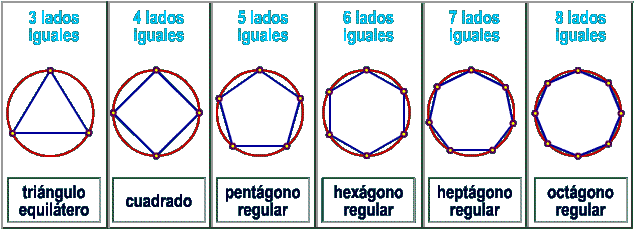
A regular polygon has all sides of equal length and all its vertices lie on a circle. They are classified as:

  • Equilateral Triangle: A regular polygon with 3 sides.
  • Square: A 4-sided regular polygon.
  • Regular Pentagon: A regular polygon with 5 sides.
  • Regular Hexagon: A 6-sided regular polygon.
  • Regular Heptagon: A regular 7-sided polygon.
  • Regular Octagon: An 8-sided regular polygon, and so on.

Regular Polygon

poligonos_regulares.gif

Irregular Polygons

An irregular polygon has sides that are not of equal length and/or its vertices do not lie on a circle. According to...

Continue reading "Understanding Polygons: Types, Properties, and Classifications" »