Notes, summaries, assignments, exams, and problems for Visual arts and art education

Mineral Characteristics: Sulfates and Carbonates

Visual arts and art education5.13 KB

Sulfate Minerals

MineralChemical FormulaHabitColorLusterDiaphaneityStreakFractureTenacityHardness
AnhydriteCaSO4RhombicWhite with grayish tinge, bluish, reddishVitreous, pearlyTranslucentGrayish whiteIrregularFragile3 - 3.5
GypsumCaSO4·2H2OPrismaticColorless, white, yellow, red, chestnutVitreous, pearly, silkyTransparent to translucentWhiteFibrous, conchoidalFragile2
BariteBaSO4RhombicIncluding white, shades of blue, or redVitreous, pearly, resinousTransparent to translucentWhiteIrregularVery fragile, brittle3 - 3.5
AnglesitePbSO4RhombicWhite, dyed yellow, gray, green, blueVitreous, resinousTransparentWhiteConchoidalFragile2.75 - 3
AluniteKAl3(SO4)2(OH)6RhombohedralWhite, gray or redVitreousTransparentWhiteIrregularFragile3.5 - 4
ChalcanthiteCuSO4·5H2OTriclinicStrong
...
Continue reading "Mineral Characteristics: Sulfates and Carbonates" »

English Verb Tenses: A Comprehensive Guide

Visual arts and art education4.25 KB

Present Continuous

Actions that are happening now.

  • Add -ing to the verb (e.g., I am talking, he/she/it is eating, you/we/they are talking).

Present Simple

Actions that happen regularly or habitually.

  • For I, you, we, and they, use the base form of the verb (e.g., talk, eats, learn).
  • For he, she, and it, add -s to the verb (e.g., talks, eats, learns).
  • For questions, use do/does and do not add -s (e.g., Do you talk?, Does he eat?).
  • For negatives, do not add -s (e.g., I don't talk, he doesn't learn).
  • Use time expressions (e.g., always, usually, often, sometimes) before the verb.

Present Perfect

Past actions that have relevance to the present.

  • For I, you, we, and they, add have.
  • For he, she, and it, add has.
  • Affirmative: I have (I've) talked to Peter, they have
...
Continue reading "English Verb Tenses: A Comprehensive Guide" »

Essential English Grammar Rules and Vocabulary

Visual arts and art education11.26 KB

English Grammar Essentials

Relative Pronouns

  • Who (that): Refers to a person.
  • Which (that): Refers to a thing or animal.
  • When: Refers to a time.
  • Whose: Refers to possession (cuyo).
  • Where: Refers to a place.

Omission Rules:

  • You can omit who, which, that when followed by a pronoun.
  • You can omit who, which, that + be when followed by a verb in the -ing form or the 3rd column (past participle).

Conditionals

  • Zero Conditional: Always true.
    Structure: IF + Present Simple --- Present Simple
  • First Conditional: Future possibility.
    Structure: IF + Present Simple --- will
  • Second Conditional: Hypothetical situations.
    Structure: IF + Past Simple (2nd column / did) --- would
  • Third Conditional: Past hypothetical situations.
    Structure: IF + Past Perfect (had + 3rd column)
...
Continue reading "Essential English Grammar Rules and Vocabulary" »

Modern Theatre: Realism to Absurdism

Visual arts and art education3.04 KB

Realism

Key Aspects of Realism

  • Observation of human behavior
  • Contemporary settings and time periods
  • Realism reflected in theatre design

Unsavory Social Topics in Realism

  • Poverty
  • Disease
  • Prostitution
  • Illegitimate children

Henrik Ibsen: The Father of Modern Drama

  • Challenged moral values and social norms
  • Wrote Ghosts, Hedda Gabler, An Enemy of the People, and A Doll's House
  • A Doll's House: "The slam heard around the world"

The Box Set: A New Style of Realism

  • True-to-life interiors
  • Full settings of rooms
  • Fourth wall

The Box Set: Imaginary

Naturalism: A Slice of Life

  • Documentary of everyday life

Georg II, Duke of Saxe-Meiningen: The First Director

Moscow Art Theatre

  • Constantin Stanislavski (Founder)
  • Anton Chekhov (Head Playwright)

The Stanislavski System: The ABCs of Acting

  • An
...
Continue reading "Modern Theatre: Realism to Absurdism" »

Visual Elements: Point, Line, Plane, & Texture in Art

Visual arts and art education4.76 KB

The Point: Foundation of Visual Form

Defining the Point

The point is the smallest element that can be drawn. Its form is considered indefinite when it is very small, as its shape is conceptually round.

Expressive Capacity of Points

The expressive capacity of the point is demonstrated when a set of points produces an effect of depth or volume. An example of this is concentration, where points grouped closely together can create a sense of density or focus.

Dimensional Capability of Points

The dimensional capability of the point also relates to how a set of points can create an effect of depth or volume. This can be achieved through techniques such as overlap, variations in size, and the use of color.

The Line: A Point in Motion

Understanding the Line

The...

Continue reading "Visual Elements: Point, Line, Plane, & Texture in Art" »

Mastering English Sentence Patterns

Visual arts and art education3.95 KB

The Verb To Be

  • Affirmative: Subject + am/is/are + complement.
  • Negative: Subject + am/is/are + not + complement.
  • Question: Question word + am/is/are + subject + complement + ?
  • Short answers: Yes/No, Subject + am/is/are + (not).

Using Have Got

  • Affirmative: Subject + have/has got + complement.
  • Negative: Subject + have/has not + got + complement.
  • Question: Question word + have/has + subject + got + complement + ?
  • Short answers: Yes/No, Subject + have/has + (not).

Comparatives and Superlatives

Comparatives

  • -y becomes -ier (e.g., happier)
  • As big as / Not as big as
  • -er / More ... than ...

Superlatives

  • -est / The most ...
  • Irregular: Good - better - the best
  • Irregular: Bad - worse - the worst
  • Irregular: Far - further - the furthest

Pronouns and Possessive Adjectives

Subject

...
Continue reading "Mastering English Sentence Patterns" »

Understanding Polygons: Types, Properties, and Classifications

Visual arts and art education3.93 KB

Polygon

A polygon is a flat geometric figure bounded by a closed traverse that does not intersect itself.

Classifying Polygons

Polygons are basically classified into:

Regular Polygons

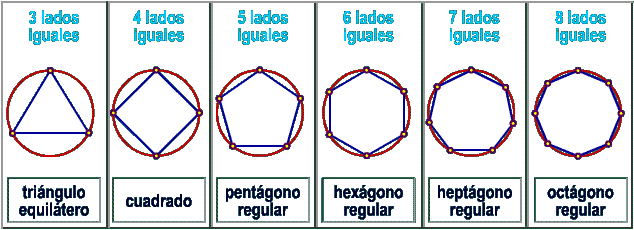
A regular polygon has all sides of equal length and all its vertices lie on a circle. They are classified as:

  • Equilateral Triangle: A regular polygon with 3 sides.
  • Square: A 4-sided regular polygon.
  • Regular Pentagon: A regular polygon with 5 sides.
  • Regular Hexagon: A 6-sided regular polygon.
  • Regular Heptagon: A regular 7-sided polygon.
  • Regular Octagon: An 8-sided regular polygon, and so on.

Regular Polygon

poligonos_regulares.gif

Irregular Polygons

An irregular polygon has sides that are not of equal length and/or its vertices do not lie on a circle. According to...

Continue reading "Understanding Polygons: Types, Properties, and Classifications" »

Medieval Art Styles: Early Christian, Byzantine, Romanesque, Gothic

Visual arts and art education3.19 KB

Early Christian Art Characteristics

Painting

Graffiti on the walls of the catacombs, primarily religious in nature.

Christian Iconography and Symbols

  • The Good Shepherd
  • Dove of Peace
  • Peacock
  • Lamb
  • Christ the Redeemer
  • The Ship (Church)
  • The Anchor Fish (Ichthys)

Colors and Materials

Colors: Vivid, highlighted in decoration on roofs, domes, and walls.

Sculpture: Images usually represented: The Good Shepherd and Virgins.

Topics/Materials: Sarcophagi and funerary urns made of wood and marble.

Architecture

Construction of the Basilica, consisting of:

  1. Atrium
  2. Rectangular room

Byzantine Art

Architecture

  1. Grandeur and scale.
  2. Introduction of the dome on pendentives; pyramidal capitals.
  3. Greek cross basilica plan.
  4. Mosaic decoration (musuvaria).

Themes: Christian themes. Materials:

...

Continue reading "Medieval Art Styles: Early Christian, Byzantine, Romanesque, Gothic" »

Sulfide Mineral Identification: Properties and Characteristics

Visual arts and art education9.65 KB

Sulfide and Sulfosalt Mineral Properties

This document details the key physical and chemical properties of various sulfide and sulfosalt minerals, focusing on characteristics such as Hardness, Habit, Fracture, Tenacity, Color, Luster, Diaphaneity, and Streak.

Hardness (H)
Measured on the Mohs scale.
Fracture
How the mineral breaks (e.g., Conchoidal, Irregular).
Tenacity
Resistance to breaking (e.g., Fragile, Sectile, Malleable, Flexible).
Luster (Brillo)
Appearance in reflected light (e.g., Metallic, Adamantine, Resinous).
Diaphaneity
Transparency (Opaque or Translucent).
Streak (Raya)
Color of the mineral's powder.

Argentite ($ ext{Ag}_2 ext{S}$)

  • Chemical Formula: $ ext{Ag}_2 ext{S}$
  • Habit: Filamentary, Dendritic, Subconchoidal.
  • Color: Black.
  • Luster: Metallic,
...
Continue reading "Sulfide Mineral Identification: Properties and Characteristics" »

Points, Lines, and Planes: Basic Graphic Elements

Visual arts and art education3.16 KB

The Point

A circle and a line are tangent if they intersect at exactly one point. Two circles are tangent if the line joining their centers is tangent to both. An oval is a closed curve formed by arcs of circles and symmetrical about two perpendicular axes. A ball is a closed curve composed of arcs symmetric about one axis.

Graphical Representation of the Point

Graphically, the point is the minimal footprint of a graphical tool. Geometrically, it is the intersection of two lines. The point can take several forms depending on the instrument used to create it: oval, star, round, polygonal, etc.

Sensory Perception of the Point

  • Single Point: Located in the center of a bracket or blade, it creates a sense of order or balance. Located at one end, it creates
...
Continue reading "Points, Lines, and Planes: Basic Graphic Elements" »