Notes, summaries, assignments, exams, and exercises for Computer science for Baccalaureate

Understanding Network Switches, IP Addressing, and Key Terms

Computer science2.96 KB

Network Switches

Managed vs. Unmanaged Switches

Managed Switch: Configurable via software, supports security and communication settings. Used in large networks (enterprise, universities).

Unmanaged Switch: Fixed configuration, hardware-only, cannot be configured.

Ethernet & Speed

  1. Fast Ethernet: 100 Mbps.
  2. Gigabit Ethernet: 1 Gbps.

Ethernet Protocol

Divides data into frames, encapsulates IP addresses, performs error detection.

Ports

  1. Console Port: Connects PC/laptop to configure switch.

Communication Modes

  • Simplex (Half Duplex): One-way communication at a time.
  • Duplex (Full Duplex): Two-way communication simultaneously.

Bandwidth

  1. Maximum transmission speed of a network, determined by signal frequency range.

IP Addressing & Subnets

  1. IP Address: Identifies
...
Continue reading "Understanding Network Switches, IP Addressing, and Key Terms" »

C Language Fundamentals: Output, Control Flow, Strings, and Sorting

Computer science22.92 KB

C printf Function: Format Specifiers Explained

The printf function in C is used to display formatted output to the standard output (usually the console). It allows programmers to control how data is presented by using **format specifiers**. Format specifiers are placeholders that define the type of data being printed and how it should be formatted. They begin with a % symbol, followed by a character that specifies the data type.

Role of Format Specifiers

Format specifiers serve two main purposes:

  1. Data Type Identification: They inform the printf function about the type of data being passed as an argument. For example, %d is used for integers, while %f is used for floating-point numbers.
  2. Formatting Control: They allow customization of how the data
...
Continue reading "C Language Fundamentals: Output, Control Flow, Strings, and Sorting" »

Computer Systems Fundamentals Cheat Sheet

Computer science3.88 KB

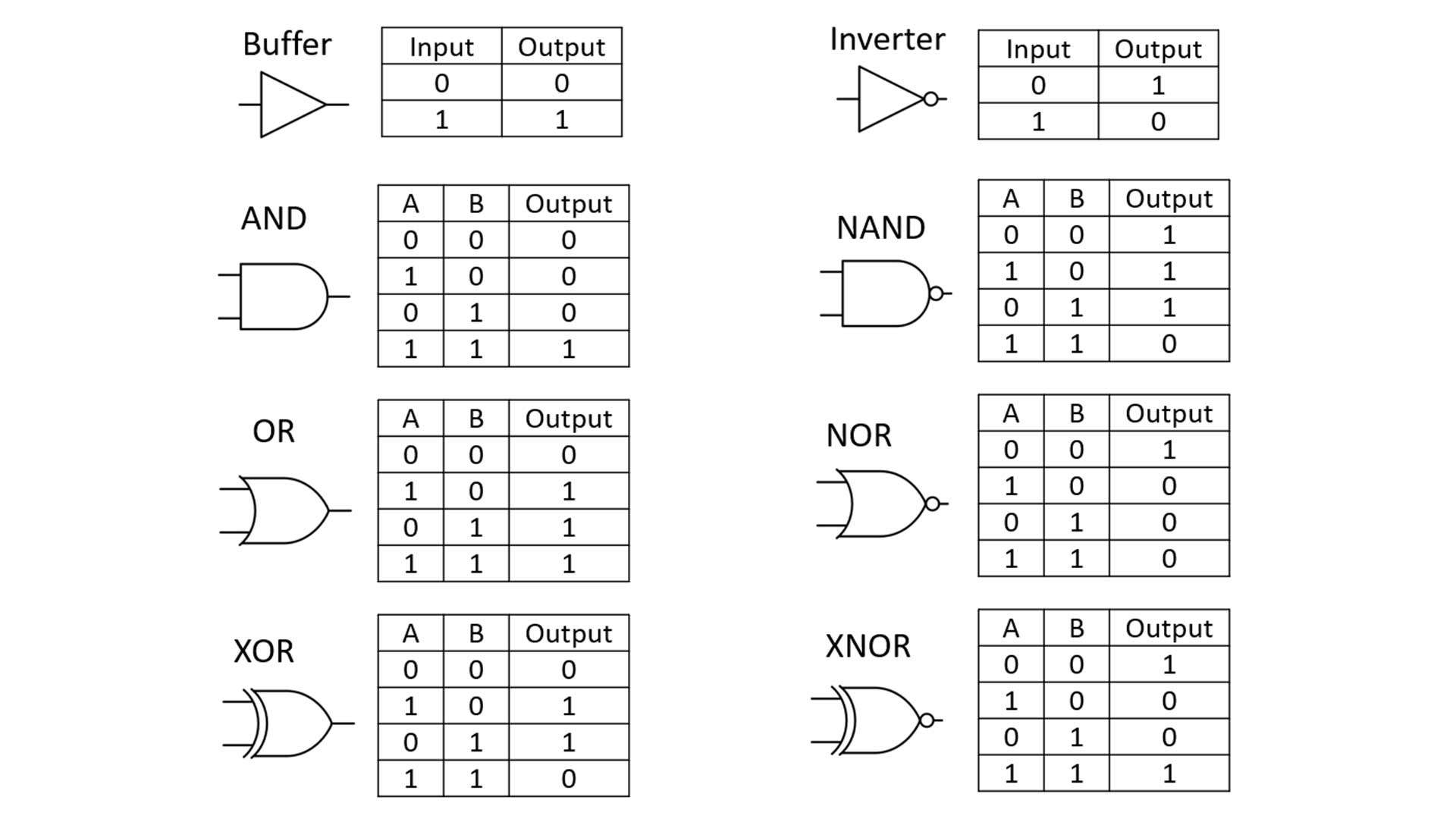
Execute Logic Gates | Bedrock Wiki Boolean Algebra Simplification with Examples

Computer Systems Fundamentals Cheat Sheet

Number Systems

  • Binary (Base 2): Digits 0 and 1.
  • Hexadecimal (Base 16): Digits 0–9 and A–F.
  • Decimal (Base 10): Digits 0–9.

Conversions

  • Binary to Decimal: Multiply each bit by 2^n from the right.
  • Decimal to Binary: Divide by 2 and record the remainders.
  • Hex to Binary: Replace each hex digit with its 4-bit binary equivalent.

Two's Complement (Signed Numbers)

  • Positive numbers: Same as unsigned.
  • Negative numbers: Invert all bits and add 1.
  • Range (n bits): -2^(n-1) to 2^(n-1) - 1.
  • Overflow: Occurs if carry into the sign bit ≠ carry out.

Boolean Algebra Rules

  • Identity: A + 0 = A, A * 1 = A
  • Null: A + 1 = 1, A * 0 = 0
  • Idempotent: A + A = A, A * A = A
  • Inverse: A + NOT A = 1, A * NOT A = 0
  • Distributive: A(B + C) = AB +
...
Continue reading "Computer Systems Fundamentals Cheat Sheet" »

Mastering Program Flow: Conditional and Iteration Structures

Computer science4.62 KB

Conditional Control Structures

Conditional control structures dictate the flow of execution by allowing specific blocks of code to run only when certain conditions are met.

1. The If Statement

The If statement executes a block of code only if the specified condition evaluates to true. Otherwise, the block is skipped entirely.

Syntax:

if (condition) {
    // statements (If Block)
}
// other statements

Note: A flow chart typically illustrates the execution path based on the condition.

2. The If-Else Statement

If the condition is true, the If block is executed. If the condition is false, the alternative Else block is executed.

Syntax:

if (condition) {
    // statements (If Block)
} else {
    // statements (Else Block)
}

3. The Else-If Ladder Statement

The...

Continue reading "Mastering Program Flow: Conditional and Iteration Structures" »

C Programming: Tokens, Operators, and Logic

Computer science2.55 KB

Tokens

In programming, a token is the smallest meaningful element in code. They are the building blocks of a language's syntax. Common token types include:

  • Keywords: Reserved words like if, else, while, and int (for declaring integers).
  • Identifiers: Names given to elements like variables (e.g., sum), functions, and arrays.
  • Constants: Unchanging values during program execution (e.g., 3.14 for pi).
  • Operators: Symbols for mathematical or logical operations (e.g., + for addition).
  • Separators: Punctuation like commas (,), semicolons (;), and braces ({}).

Example: int sum = 10 + 5;

In this line, int is a keyword, sum is an identifier, = is an operator, 10 and 5 are constants, and ; is a separator.

Arithmetic Operators

C has nine arithmetic operators for basic...

Continue reading "C Programming: Tokens, Operators, and Logic" »

Flowcharts, Programming Languages, and the C Language

Computer science5.56 KB

Understanding Flowcharts

The pictorial or graphical representation of the flow of a program is known as a flowchart. If algorithms or programs are displayed in the form of a picture, then it will be more noticeable and recognizable. We only need to know some specific shapes to represent each process or action. The fundamental shapes and descriptions used in flowcharts are as follows:

  • Rhombus: For decision-making and branching the flow of execution.
  • Rectangle: For processing and assigning variables.
  • Parallelogram: Accessing inputs and printing outputs.
  • Rectangle with Curved Edges: Start/Begin or Stop/End of the program execution.
  • Circle: Connectors to continue the flow of execution.
  • Arrow: Represents the direction of the flow of execution.

j9uY63M2wBnveRcyLNUIT34Tu4aWeSqdlhox9JkprjEzmiyBmtmP8KZOE9ItyPleqb820RulOWNBK3GMhvqLvE3HpnmwwrHzb7DE88UBI3YtVUPP5F33nd5VQA0aF_e2ICZ6AW7YV-ajFuT7HcyJt-c4Xh9Iektloljd0DiRGjXFpHgP_xKeDfpPLZEH2Q


Programming

...
Continue reading "Flowcharts, Programming Languages, and the C Language" »

Understanding Mobile Development: The Viewport Meta Tag

Computer science735 bytes

Mobile Development: The Viewport Meta Tag

The viewport meta tag is crucial for responsive web design on mobile devices. It controls how the browser displays a webpage on different screen sizes. Here's a breakdown of its key attributes:

Key Attributes

  • width: Defines the viewport width. Typically set to device-width, which matches the device's screen width.
  • initial-scale: Sets the initial zoom level. A value of 1 ensures the webpage is displayed at 100% zoom initially.
  • user-scalable: A boolean attribute. Setting it to no prevents users from zooming in or out.

ADO.NET DataReader vs DataSet: Choosing the Right Data Object

Computer science2.89 KB

DataReader Object in ADO.NET

The DataReader object in ADO.NET is used to read data from a data source in a fast, forward-only, and read-only manner. It is ideal for scenarios where you need to retrieve large amounts of data efficiently without storing it entirely in memory.

Key Characteristics of DataReader

  • Forward-Only: The DataReader allows data to be read only in a forward direction. Once a record is read, you cannot go back to previous records.
  • Read-Only: The data fetched through the DataReader cannot be modified. It is designed purely for reading data.
  • Connected Architecture: The DataReader works with an open connection to the data source. The connection remains open as long as the DataReader is being used, making it a connected object.
  • Efficient
...
Continue reading "ADO.NET DataReader vs DataSet: Choosing the Right Data Object" »

Core Concepts in Artificial Intelligence: Search Algorithms and Knowledge Systems

Computer science15.96 KB

Heuristic Search Techniques Explained

Heuristic search techniques use intelligent estimations to find solutions efficiently. These methods help in decision-making by prioritizing the most promising paths.


1. Greedy Best-First Search (GBFS)

  • Always chooses the next step that appears closest to the goal.
  • Ignores the cost already traveled.

Example:

A person finding the exit of a maze by always taking the path that looks shortest.

⚠ Risk: May lead to dead ends.


2. A* Search Algorithm

  • Balances actual cost and estimated cost to reach the goal.
  • Ensures the shortest and most efficient path.

Example:

Google Maps finds the best route by considering both distance already covered and the remaining estimated distance.

✅ Optimal and efficient.


3. Hill Climbing Algorithm

  • Moves
...
Continue reading "Core Concepts in Artificial Intelligence: Search Algorithms and Knowledge Systems" »

Python Programming Essentials: Core Concepts & Techniques

Computer science1.35 MB

Understanding Variables & Data Types

Variables: Storing Data

Variables are containers used to store data. They are assigned values using the = operator (e.g., x = 5).

Essential Data Types

Python supports several fundamental data types:

  • int: Represents integer numbers (e.g., 10, -5).
  • float: Represents floating-point numbers (e.g., 3.14, -0.01).
  • str: Represents strings of characters (e.g., "hello", "123").
  • bool: Represents Boolean values, either True or False.

GOQmZWnx2PAAAAABJRU5ErkJggg==

Type Casting: Converting Data Types

Type casting allows you to convert data from one type to another using functions like int(), float(), and str().

Example: x = int("5") converts the string "5" to an integer. y = float("3.14") converts the string "3.14" to a float.

Input and Output Operations

Getting

...
Continue reading "Python Programming Essentials: Core Concepts & Techniques" »