Notes, summaries, assignments, exams, and exercises for Biology for Baccalaureate

Understanding Non-Infectious Diseases: Types & Causes

Biology3.61 KB

Non-Infectious Diseases

Cardiovascular Diseases

Cardiovascular diseases affect the heart and blood vessels, and their incidence is higher in adults and the elderly.

  • Atherosclerosis: An enlargement of the walls of the arteries due to the deposition of cholesterol, platelets, and fibrous tissue. The arteries can become calcified and hardened, resulting in a loss of elasticity.
  • Thrombus: A blood clot that occurs in an artery or vein, leading to its obstruction (thrombosis). When the clot forms in a vein, it can be released and easily move to another place (embolism).
  • Aneurysm: A weakening of the arterial wall, which promotes dilation of the artery. This can rupture and form a hemorrhage.
  • Stroke: Interruption of blood supply to the brain.
  • Coronary Artery
...
Continue reading "Understanding Non-Infectious Diseases: Types & Causes" »

Nitrogen and Carbon Cycles: Essential Biogeochemical Processes

Biology2.69 KB

The Biogeochemical Cycle of Nitrogen

Nitrogen constitutes 78% of the troposphere. However, in this gaseous form (N2), it cannot be used directly as a nutrient by plants or animals. It must first be converted into usable forms through a process called nitrogen fixation.

Key Steps in Nitrogen Conversion

The conversion of nitrogen involves several specialized bacterial processes:

  • Nitrogen Fixation: Some bacteria reduce atmospheric N2 to form ammonia (NH3).
  • Nitrosation: Ammonia is transformed by a specialized group of bacteria (such as the genus Nitrosomonas) that oxidize it, forming nitrite (NO2-). This process is called nitrosation.
  • Nitrification: Bacteria of the genus Nitrobacter oxidize the nitrite ion, converting it to nitrate (NO3-), which is the
...
Continue reading "Nitrogen and Carbon Cycles: Essential Biogeochemical Processes" »

The Biological Foundations of Life and Evolutionary Theory

Biology2.82 KB

The Recipe of Life

The fundamental elements of life are Carbon, Hydrogen, Oxygen, and Nitrogen.

Essential Composite Materials

Life requires specific elements to function, including Selenium, Iron, Sulfur, and Potassium.

Energy for Photosynthetic Life

Life energy is produced through a process called photosynthesis, utilized by plants, algae, and bacteria. These organisms are classified into two main groups:

  • Autotrophic: Organisms that produce their own food.
  • Heterotrophic: Organisms that consume other organic substances.

Chemosynthesis

Some bacteria derive energy from chemical reactions with elements and compounds, such as hydrogen sulfides emitted by volcanoes.

Carbon Origins

Carbon originates from within the Earth, accumulating since the planet's formation....

Continue reading "The Biological Foundations of Life and Evolutionary Theory" »

Amphibian Embryonic Development and Organogenesis

Biology2.6 KB

Organogenesis in Pluteus Larvae

From the formation of the Pluteus larva, individual organs will separate. As different body organs develop, the larva grows until it reaches the normal adult size of the species.

Amphibian Embryonic Development

Amphibian fertilization is external; the female lays eggs enveloped in a gelatinous mass, and the male ejects sperm onto the eggs to fertilize them.

  • The eggs are mesolecithal (they have a moderate amount of yolk).

Segmentation and Cleavage

The first meridional division occurs 2-3 hours after fertilization. The second is made by a plane perpendicular to the first. The segmentation is holoblastic (total) and unequal. Eight blastomeres are originated: 4 small micromeres and 4 large macromeres.

The Blastula Stage

The...

Continue reading "Amphibian Embryonic Development and Organogenesis" »

Structure and Function of the Cell Membrane

Biology4.3 KB

Structure and Function of the Plasma Membrane

The plasma membrane delimits the cell. Its structure is virtually identical to the membranes that enclose various cytoplasmic organelles, such as the Golgi apparatus. This is commonly referred to as the unit membrane or cellular membrane.

It consists of a lipid bilayer associated with protein molecules. The primary lipid components are phospholipids (the most abundant), glycolipids, and cholesterol.

Membrane Proteins and Asymmetry

The membrane is asymmetric. Proteins are structured in such a way that their polar radicals face outward, while their lipophilic radicals establish contact with the lipophilic core of the membrane lipids. Membrane proteins are classified into three main groups:

  • Integral proteins:
...
Continue reading "Structure and Function of the Cell Membrane" »

Understanding Nucleic Acids, Genetics, and Cellular Biology

Biology3.44 KB

Bright Cyclic Electron Flow

The electrons freed after reaching ferredoxin are passed to plastoquinone and follow the electron transport chain to return to the plastocyanin and photosystem I.

Nucleic Acids

Nucleic acids are macromolecules composed of repeating polymers of monomers called nucleotides linked by phosphodiester bonds.

Types of Nucleic Acids

  • The sugar (pentose) present: deoxyribose in DNA and ribose in RNA.
  • The nitrogen-containing bases: adenine, guanine, cytosine, and thymine in DNA; adenine, guanine, cytosine, and uracil in RNA.
  • In eukaryotes, DNA has a double-stranded structure, while RNA is typically single-stranded. RNA can occur in extended form, such as mRNA, or in folded form, such as tRNA and rRNA.
  • The molecular mass of DNA is generally
...
Continue reading "Understanding Nucleic Acids, Genetics, and Cellular Biology" »

Understanding Infectious Diseases and the Immune System

Biology3.05 KB

Infectious Disease

is caused by agents that have invaded the body

Pathogen

any agent that causes disease

Koch Postulates

rules for determining the cause of a disease

Mucous Membrane

epithelial tissue that protects the inferior surface of the body that might be exposed to pathogens

Inflammatory Response

events that suppress infection and speed recovery

Histamine

substance that increases the permeability of surrounding capillaries

Phagocytes

type of white blood cell that pass through capillary walls, ingest and destroy foreign matter

Neutrophil

type of phagocyte that squeeze through capillary walls

Macrophage

type of phagocyte that engulfs pathogens and cellular debris

Natural Killer Cells

large white blood cells that attack pathogen-infected cells

Complement System

proteins...

Continue reading "Understanding Infectious Diseases and the Immune System" »

Understanding the Human Nervous System and Brain Functions

Biology2.91 KB

The Nervous System

The nervous system allows us to respond to changes in our environment and coordinate our actions. It consists of two key parts:

  • Central Nervous System (CNS)
  • Peripheral Nervous System (PNS)

The Peripheral Nervous System

The peripheral nervous system is divided into two components:

  • Autonomic Nervous System: Controls unconscious activities. It is further split into the sympathetic nervous system (prepares the body for action) and the parasympathetic nervous system (calms the body down).
  • Somatic Nervous System: Controls conscious activities and connects the CNS with the senses.

Neurons and Neurotransmission

Cells of the nervous system are called neurons (nerve cells). They transmit information as electrical impulses throughout the body....

Continue reading "Understanding the Human Nervous System and Brain Functions" »

Human Circulatory and Immune System Fundamentals

Biology3.97 KB

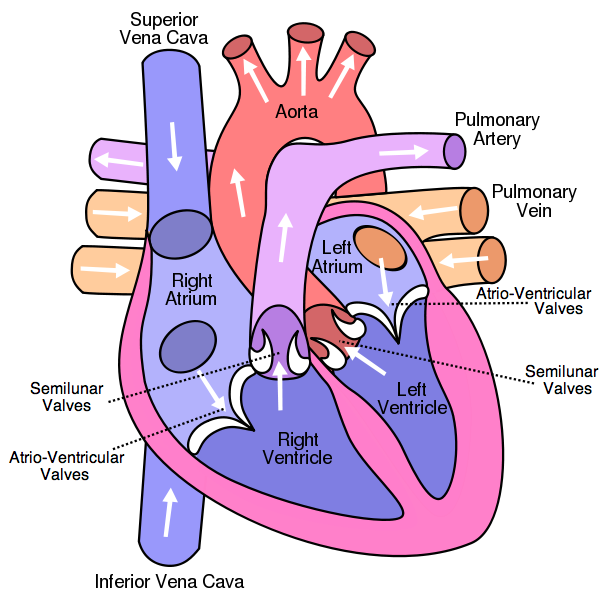
The Human Heart: Chambers, Vessels, and Blood Flow

Diagram of the human heart showing chambers, vessels, valves, and blood flow

Heart Action: Blood Collection, Pumping, and Valve Function

The right atrium collects blood from the superior and inferior vena cava, and the left atrium collects blood from the pulmonary veins. This blood then flows into the right and left ventricles, which pump the blood into the arteries. The direction of blood flow is controlled by the atrioventricular valves and semilunar valves. When the atria contract, the blood flows through the open atrioventricular valves into the ventricles. At this stage, the semilunar valves are closed, so the ventricles fill with blood. The ventricles then contract, which causes a rise in pressure. This rise in pressure first causes the atrioventricular valves to...

Continue reading "Human Circulatory and Immune System Fundamentals" »

Plant Waste, Respiration, and Vertebrate Urine Formation

Biology2.82 KB

Plant Waste Products

Gaseous substances: These include carbon dioxide and ethylene. Carbon dioxide is removed via stomata and lenticels, while ethylene is found in ripe fruits.

Liquid substances:

  • Essential oils are expelled to the outside (ciliary ganglion) or stored (oleifera bags).
  • Resins accumulate in the resin canals.
  • Latex is stored within laticiferous channels.

Solid substances: Calcium oxalate accumulates as crystals in cell vacuoles.

Plant Respiration

Plants, like most living organisms, require oxygen for cellular respiration. As photosynthetic organisms, they also require carbon dioxide to synthesize their own organic matter. The addition of these gases does not require a respiratory apparatus as in animals, due to the following peculiarities:...

Continue reading "Plant Waste, Respiration, and Vertebrate Urine Formation" »