
Notes, summaries, assignments, exams, and exercises for Visual arts and art education for Secondary education

Una historia en ingles simple present,simple past,future,past continuous y present continuous

Visual arts and art education1.28 KB

Past Simple: acciones pasadas.
S+V-ED+RESTO.
S+DIDN'T+FORMA BASE V+ RESTO.
DID+S+FBV+R?
WAS/WERE:
I WAS YOU WERE HE/SHE/IT WAS ...WERE.
PAST CONTINUOUS: OCURRIENDO EN EL PASADO.
S+WAS/WERE+V-ING+RESTO.
S+WASN'T/WEREN'T+V-ING+RESTO
WAS/WERE+S+V-ING+RESTO?
WILL:IF.
IF+PRESENT SIMPLE+WILL+VP.
BE GOING TO: PLANES.
S+TO BE+GOING TO+V+R
TO BE NEGADO
TO BE+S+GOING TO+V+R
PRESENT PERFECT: ACCIONES CON REPERCUSION.
S+HAVE/HAS+PARTICIPIO+R
HAVEN'T/HASN'T
HAVE/HAS+S+P+R?
MIO MINE TUYO YOURS SUYO HIS HERS ITS
NUESTRO OURS VUESTRO YOURS SUYO THEIRS
The Complete Guide to Manicures and Pedicures

Visual arts and art education9.15 KB

Manicure A/B/C

1. Julissa used the buffer (C) - an object that makes nails shiny.

2. The nail technician was careful not to cut too much of the cuticle (B) - the skin around the nail.

3. Max cleaned the dirt from his nails with a nail brush (A) - an object with stiff pieces of plastic used to clean nails.

RELLENAR

1. Kate put her hands in the finger bowl, which was full of soapy water.

2. A manicurist trims dead skin from around a client's nails with a cuticle trimmer.

3. After a long day at work, Max soaks his tired feet in warm water.

4. Penny often files the rough edges of her nails to keep them smooth.

5. Wendy showed her sister how to push back her cuticles with an orange stick.

INTERES

1. What is the purpose of the guide?: (d) to explain the steps...

Continue reading "The Complete Guide to Manicures and Pedicures" »

Fundamentals of Color Theory: Light and Pigment Mixing

Visual arts and art education3.14 KB

1. Additive Color Mixtures (Light)

We can derive all colors from three primary colors of light: Red, Green, and Blue (RGB).

An additive mixture is created when colored lights are mixed, because we are adding light energy each time. Mixing two primary colors results in secondary colors:

  • Blue Light + Green Light = Cyan Light
  • Green Light + Red Light = Yellow Light
  • Blue Light + Red Light = Magenta Light

When combining all three primary colors of light, the result is white light.

Color Descriptions in Additive Systems

In this context, blue refers to a more blue-violet color; red is often a red-orange; magenta is similar to fuchsia pink; and cyan is a bright blue.

2. Subtractive Color Mixtures (Pigments)

Color pigments, such as the paints used on paper, are...

Continue reading "Fundamentals of Color Theory: Light and Pigment Mixing" »

Understanding Color: Rainbows, Light, Pigments, and Saturation

Visual arts and art education2.45 KB

Understanding Color: Rainbows, Light, and Pigments

A rainbow occurs when sunlight passes through raindrops, separating the light into seven colored lights.

Absorption conveys the feeling of color when light illuminates an object. The object's surface absorbs some of the light. This property is called the absorption of light.

Reflection is when light is not absorbed but rejected, changing direction and creating the sensation of color.

Color is the name for each color and describes the colors that comprise their mixture (e.g., yellow and green make yellow-green).

Value and Saturation

Value describes the degree of clarity or obscurity of a tone, i.e., the amount of white or black in the composition. For example, magenta can be light, dark, or very dark....

Continue reading "Understanding Color: Rainbows, Light, Pigments, and Saturation" »

Mastering English Sentence Patterns

Visual arts and art education3.95 KB

The Verb To Be

  • Affirmative: Subject + am/is/are + complement.
  • Negative: Subject + am/is/are + not + complement.
  • Question: Question word + am/is/are + subject + complement + ?
  • Short answers: Yes/No, Subject + am/is/are + (not).

Using Have Got

  • Affirmative: Subject + have/has got + complement.
  • Negative: Subject + have/has not + got + complement.
  • Question: Question word + have/has + subject + got + complement + ?
  • Short answers: Yes/No, Subject + have/has + (not).

Comparatives and Superlatives

Comparatives

  • -y becomes -ier (e.g., happier)
  • As big as / Not as big as
  • -er / More ... than ...

Superlatives

  • -est / The most ...
  • Irregular: Good - better - the best
  • Irregular: Bad - worse - the worst
  • Irregular: Far - further - the furthest

Pronouns and Possessive Adjectives

Subject

...
Continue reading "Mastering English Sentence Patterns" »

English Grammar: Tenses, Passive Voice, Conditionals, and More

Visual arts and art education6.48 KB

Verb Tenses

Past Simple

Structure: Subject + Verb (past form or -ed) or 3rd column; Negative: didn't + base form.

Uses: Completed actions in the past (with expressions like last, ago, yesterday, in 1992).

Past Continuous

Structure: was/were + verb-ing.

Uses: Actions in progress in the past; Past Continuous + when + Past Simple or Past Continuous + while + Past Continuous.

Past Perfect

Structure: had + past participle (verb-ed or 3rd column).

Uses: An action that happened before another action in the past (with expressions like after, before).

Future Simple (Will)

Structure: will + base form.

Uses: Weather, promises, future predictions, spontaneous decisions.

To Be Going To

Structure: is/am/are + going to + base form.

Uses: Future plans.

Present Simple

Uses:

...
Continue reading "English Grammar: Tenses, Passive Voice, Conditionals, and More" »

Visual Elements: Point, Line, Plane, & Texture in Art

Visual arts and art education4.76 KB

The Point: Foundation of Visual Form

Defining the Point

The point is the smallest element that can be drawn. Its form is considered indefinite when it is very small, as its shape is conceptually round.

Expressive Capacity of Points

The expressive capacity of the point is demonstrated when a set of points produces an effect of depth or volume. An example of this is concentration, where points grouped closely together can create a sense of density or focus.

Dimensional Capability of Points

The dimensional capability of the point also relates to how a set of points can create an effect of depth or volume. This can be achieved through techniques such as overlap, variations in size, and the use of color.

The Line: A Point in Motion

Understanding the Line

The...

Continue reading "Visual Elements: Point, Line, Plane, & Texture in Art" »

Medieval Art Styles: Early Christian, Byzantine, Romanesque, Gothic

Visual arts and art education3.19 KB

Early Christian Art Characteristics

Painting

Graffiti on the walls of the catacombs, primarily religious in nature.

Christian Iconography and Symbols

  • The Good Shepherd
  • Dove of Peace
  • Peacock
  • Lamb
  • Christ the Redeemer
  • The Ship (Church)
  • The Anchor Fish (Ichthys)

Colors and Materials

Colors: Vivid, highlighted in decoration on roofs, domes, and walls.

Sculpture: Images usually represented: The Good Shepherd and Virgins.

Topics/Materials: Sarcophagi and funerary urns made of wood and marble.

Architecture

Construction of the Basilica, consisting of:

  1. Atrium
  2. Rectangular room

Byzantine Art

Architecture

  1. Grandeur and scale.
  2. Introduction of the dome on pendentives; pyramidal capitals.
  3. Greek cross basilica plan.
  4. Mosaic decoration (musuvaria).

Themes: Christian themes. Materials:

...
Continue reading "Medieval Art Styles: Early Christian, Byzantine, Romanesque, Gothic" »

Understanding Polygons: Types, Properties, and Classifications

Visual arts and art education3.93 KB

Polygon

A polygon is a flat geometric figure bounded by a closed traverse that does not intersect itself.

Classifying Polygons

Polygons are basically classified into:

Regular Polygons

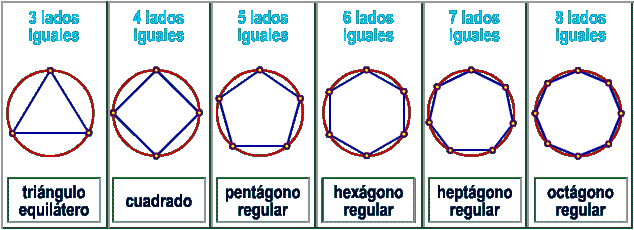
A regular polygon has all sides of equal length and all its vertices lie on a circle. They are classified as:

  • Equilateral Triangle: A regular polygon with 3 sides.
  • Square: A 4-sided regular polygon.
  • Regular Pentagon: A regular polygon with 5 sides.
  • Regular Hexagon: A 6-sided regular polygon.
  • Regular Heptagon: A regular 7-sided polygon.
  • Regular Octagon: An 8-sided regular polygon, and so on.

Regular Polygon

poligonos_regulares.gif

Irregular Polygons

An irregular polygon has sides that are not of equal length and/or its vertices do not lie on a circle. According to...

Continue reading "Understanding Polygons: Types, Properties, and Classifications" »

Points, Lines, and Planes: Basic Graphic Elements

Visual arts and art education3.16 KB

The Point

A circle and a line are tangent if they intersect at exactly one point. Two circles are tangent if the line joining their centers is tangent to both. An oval is a closed curve formed by arcs of circles and symmetrical about two perpendicular axes. A ball is a closed curve composed of arcs symmetric about one axis.

Graphical Representation of the Point

Graphically, the point is the minimal footprint of a graphical tool. Geometrically, it is the intersection of two lines. The point can take several forms depending on the instrument used to create it: oval, star, round, polygonal, etc.

Sensory Perception of the Point

  • Single Point: Located in the center of a bracket or blade, it creates a sense of order or balance. Located at one end, it creates
...
Continue reading "Points, Lines, and Planes: Basic Graphic Elements" »