Notes, summaries, assignments, exams, and exercises for Mathematics for Secondary education

Essential Concepts of Ratios, Proportions, and Percentages

Mathematics2.64 KB

Fundamentals of Ratios and Proportions

Defining Ratios and Proportions

  • Ratio: A ratio of two numbers is their quotient.
  • Proportion: A proportion exists when we have two ratios whose quotients are equal.

Key Properties of Proportions

The terms in a proportion are often referred to as means and extremes (or ends).

Example: $2/4 = 3/6$

The Fundamental Property of Proportions states that the product of the extremes is equal to the product of the means. This property is essential for finding an unknown term.

Constant of Proportionality

The constant of proportionality is the ratio (quotient) of any of the corresponding terms in the proportion.

Understanding Proportionality

Magnitudes and Measurement

A magnitude is a measurable characteristic, such as:

  • Length
  • Volume
  • Weight
  • Mass
  • Temperature

Direct

...
Continue reading "Essential Concepts of Ratios, Proportions, and Percentages" »

Machine Learning Model Performance: Boosting, Evaluation, and Validation

Mathematics12.88 KB

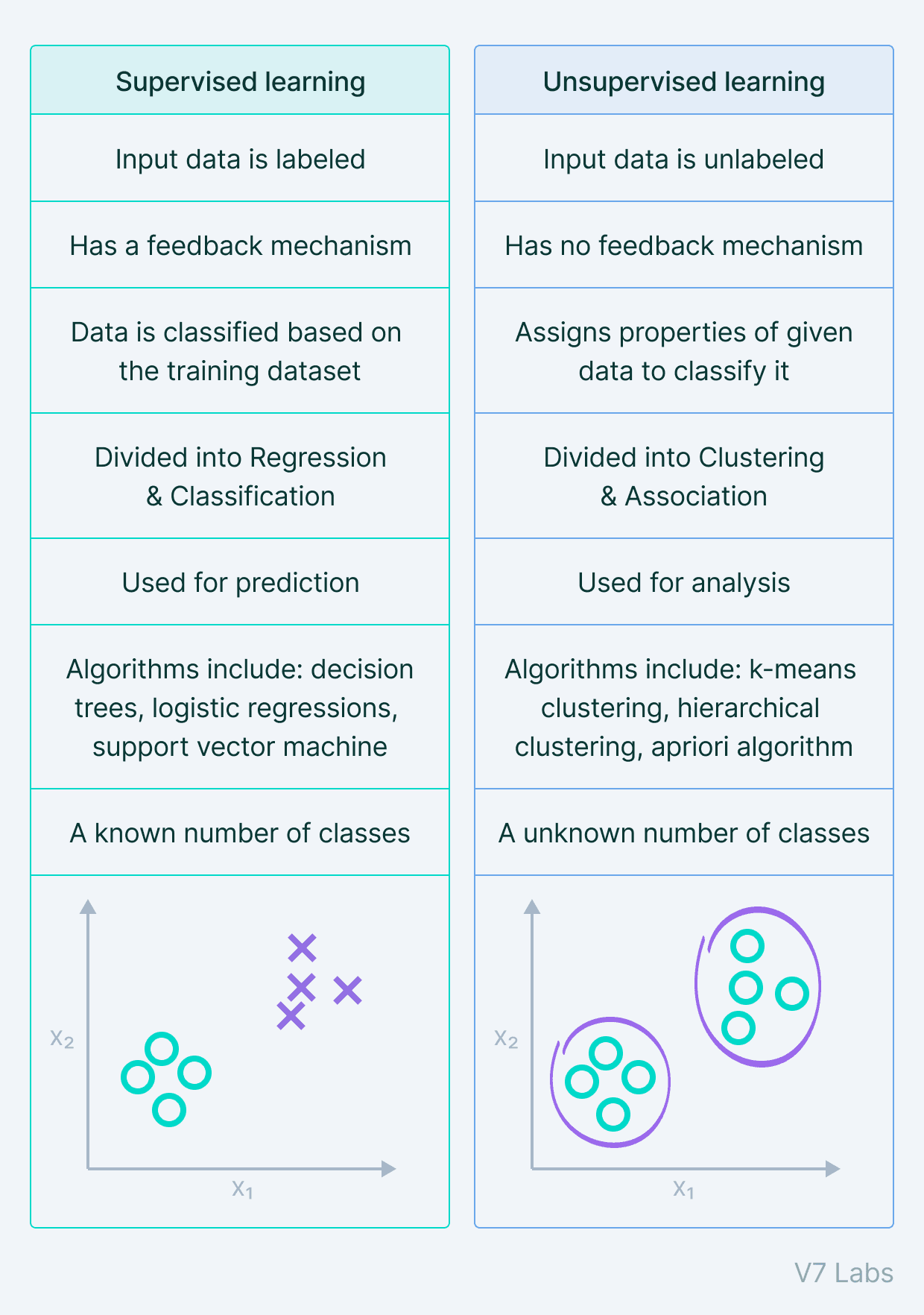
Supervised vs Unsupervised learning


AdaBoost: Adaptive Boosting Algorithm Explained

AdaBoost (Adaptive Boosting) is a classic and widely used boosting algorithm that focuses on correcting the errors of preceding weak learners (typically decision trees). It works by iteratively adjusting the weights of the training data points.

How AdaBoost Works

  1. Initial Weights: AdaBoost starts by assigning equal weights to all the training data points.
  2. Train a Weak Learner: A "weak" learner (a model that performs slightly better than random chance, like a decision stump) is trained on the dataset using the current weights.
  3. Calculate Error and Performance: The error rate of the weak learner is calculated based on the instances it misclassified. A measure of the weak learner's performance (often called
...
Continue reading "Machine Learning Model Performance: Boosting, Evaluation, and Validation" »

Accounting Fundamentals: Journal, Ledger, Trial Balance, Bills & Notes

Mathematics4.62 KB

Journal Entries: Recording Business Transactions

Format of Journal Entries

DateParticularsDebit (₹)Credit (₹)
YYYY-MM-DDDebit Account (Dr)Amount
To Credit Account (Cr)Amount
(Brief description/Narration)

Examples of Journal Entries

  1. Started Business with Cash ₹1,00,000

    • Cash A/c Dr ₹1,00,000
      To Capital A/c ₹1,00,000
    • (Being business started with cash)
  2. Purchased Goods for Cash ₹20,000

    • Purchases A/c Dr ₹20,000
      To Cash A/c ₹20,000
    • (Being goods purchased for cash)
  3. Sold Goods to Priya for ₹10,000 on Credit

    • Priya A/c Dr ₹10,000
      To Sales A/c ₹10,000
    • (Being goods sold to Priya on credit)
  4. Paid Rent ₹5,000

    • Rent A/c Dr ₹5,000
      To Cash A/c ₹5,000
    • (Being rent paid in cash)

Ledger Posting: Classifying Transactions

Format of Ledger Accounts

ParticularsJ.F.
...
Continue reading "Accounting Fundamentals: Journal, Ledger, Trial Balance, Bills & Notes" »

Understanding Sensitivity Analysis in Linear Programming

Mathematics2.76 KB

Sensitivity Analysis: The study of how changes in the coefficients of a linear programming problem affect the optimal solution.

Objective Function Coefficient Allowable Increase (Decrease): The allowable increase (decrease) of an objective function coefficient is the amount the coefficient may increase (decrease) without causing any change in the values of the decision variables in the optimal solution. The allowable increase/decrease for the objective function coefficients can be used to calculate the range of optimality.

Objective Coefficient Range (Range of Optimality): The range of values over which an objective function coefficient may vary without causing any change in the values of the decision variables in the optimal solution.

Shadow

...
Continue reading "Understanding Sensitivity Analysis in Linear Programming" »

Single-Factor ANOVA: Analysis, Assumptions, and Application

Mathematics3.03 KB

Single-Factor ANOVA is used to determine whether three or more populations have equal means.

ANOVA Assumptions:

  • The population values are normally distributed.
  • The variances for each population are equal.
  • The samples are independent.
  • The data measurement is interval or ratio level.

ANOVA is an analysis of variance. It needs to have equal variance in order to test the means.

Single-Factor ANOVA: analysis of variance design in which independent samples are obtained from two or more levels of a single factor for the purpose of testing whether the levels have equal means.

Type of data used in ANOVA: ratio or interval data (numbers).

H0: all means are equal.

H1: there is a difference in means.

Theory: Practicality.

In Multifactor ANOVA:

  • Groups: rows (router
...
Continue reading "Single-Factor ANOVA: Analysis, Assumptions, and Application" »

Key Geometric Theorems and Triangle Classification

Mathematics3.23 KB

1. Thales' Theorem and Similar Triangles

Thales' Theorem is fundamental in geometry. It states that if a straight line is drawn parallel to one side of a triangle, it divides the other two sides proportionally, creating a smaller triangle that is similar to the original one.

The theorem is valid only for similar triangles. For example, given a triangle ABC, if we trace a segment MN parallel to one side, we obtain a smaller triangle AMN similar to ABC.

Criteria for Triangle Similarity

Two triangles are considered similar if they satisfy any of the following premises:

  • Their corresponding sides are proportional.
  • They have two corresponding angles equal (which implies all three angles are equal).
  • They have one equal angle, and the sides forming that angle
...
Continue reading "Key Geometric Theorems and Triangle Classification" »

Essential Geometry Definitions and Formulas

Mathematics6.71 KB

Fundamental Geometric Concepts

Basic Geometric Elements

  • Line: A straight path without beginning or end, extending infinitely in both directions.
  • Ray: A straight path that has a beginning point but no end, extending infinitely in one direction.
  • Segment: A straight path delimited by two distinct endpoints.
  • Angle: The opening formed by two rays that share a common starting point (vertex).

Relationships Between Lines

  • Intersecting Lines (Secant): Lines that cross each other at a single point.
  • Parallel Lines: Lines that lie in the same plane and never intersect, having nothing in common.
  • Coincident Lines: Lines that occupy the exact same position, sharing all points in common.
  • Perpendicular Lines: Lines that intersect to form four equal (90-degree) angles,
...
Continue reading "Essential Geometry Definitions and Formulas" »

Understanding Payment Methods: Receipts, Cards, and Checks

Mathematics2.8 KB

What Is a Receipt?

A receipt is a document confirming the payment of a specific sum of money. It serves as proof of payment from the person who receives the money to the subscriber. The issuer retains a copy or a matrix for their records.

Required Receipt Data

  • Name and correlative number of the issuer.
  • Identification of the person or entity paying.
  • Amount paid, expressed in both numbers and words.
  • Concept or reason for the payment.
  • Place and date of issuance.
  • ID, signature, and stamp of the issuer.

Payment Methods

Cash

Direct physical currency payment.

Bank Cards

Plastic documents issued by financial entities that enable holders to pay electronically.

Types of Cards

  • Debit Card: Used to withdraw money from ATMs and pay in stores; expenditures are recorded
...
Continue reading "Understanding Payment Methods: Receipts, Cards, and Checks" »

Understanding Sequences, Progressions, and Functions in Math

Mathematics3.06 KB

Understanding Sequences, Progressions, and Functions

Sequences

Sequences are unlimited strings of real numbers. Each of the numbers that form a sequence is a term and is designated with a letter and an index that indicates its position in the sequence. The general term is the algebraic expression used to calculate any term, depending on the index.

Recurrent Sequences

Recurrent sequences are those in which terms are defined based on one given earlier, according to a known algebraic expression.

Arithmetic Progressions

A sequence of rational numbers is an arithmetic progression if each term is obtained from the previous one by adding a fixed number, or difference, usually represented by *d*. The general term is: W = A1 + (n-1) * d.

Geometric Progressions

A...

Continue reading "Understanding Sequences, Progressions, and Functions in Math" »

Fiction Book Sales Performance: 2006-2010 Market Trends

Mathematics3.42 KB

Oxford University Business Course Inquiry

Dear Sir or Madam,

I am writing to request more information about your Business Course at Oxford University. I am very interested in this course and would love to apply for it at your prestigious university in 2020.

Academic and English Language Requirements

I am currently studying Administration in Spain. Firstly, I would like to inquire about the acceptance of this qualification: could you please indicate if my Spanish Administration qualification is among your accepted entry requirements? If so, I would be grateful if you could also specify the academic entry requirements for Spanish students at Oxford University.

Secondly, I would greatly appreciate some information regarding the English Language Requirements...

Continue reading "Fiction Book Sales Performance: 2006-2010 Market Trends" »