Notes, summaries, assignments, exams, and problems for Computer science

JavaScript Fundamentals: Quick Reference Cheat Sheet

Computer science2.61 KB

JavaScript Fundamentals Cheat Sheet

1. Variables

  • let: Used to declare variables that are block-scoped. This means they only exist within the block they are defined in (e.g., inside a loop or an if statement).
  • const: Used for constants, which are also block-scoped. Once assigned a value, they cannot be reassigned.
  • var: Declares variables that are function-scoped. This can lead to issues with variable hoisting and is generally less preferred in modern JavaScript.

2. Functions

  • Functions are reusable blocks of code designed to perform a specific task. They can take parameters (inputs) and can return values.
  • Functions can be defined in different ways, including traditional function declarations and arrow functions, which provide a more concise syntax.

3.

...
Continue reading "JavaScript Fundamentals: Quick Reference Cheat Sheet" »

Computer Science Keys: Types, Uses & Security

Computer science3.27 KB

Computer Science Keys: Types and Uses

Definition — Instance 1

In computer science, a key refers to a unique identifier or a combination of values that is used to:

  1. Identify a record or a row in a database table.
  2. Authenticate users or devices.
  3. Encrypt or decrypt data.

Types of keys:

  1. Primary Key: A unique identifier for a record in a database table.
  2. Foreign Key: A field that links two tables together.
  3. Unique Key: Ensures that each value is unique.
  4. Composite Key: A combination of two or more fields used as a primary key.
  5. Encryption Key: Used to secure data by converting it into an unreadable format.
  6. API Key: Used to authenticate and authorize access to APIs (Application Programming Interfaces).

Keys play a crucial role in maintaining data integrity, ensuring...

Continue reading "Computer Science Keys: Types, Uses & Security" »

Java Programming: Classes, Objects, and Key Concepts

Computer science5.28 KB

Classes (الصفوف)

  • A class consists of variables (fields) and methods.
  • Variables are data members of a class.
  • Methods are functions that define the class's behavior.

Variables (المتغيرات)

  • Declared with a data type and a name.
  • Can be public or private.
  • Examples: int age, String name.

Methods (الأساليب)

  • Functions that perform specific tasks.
  • Can have parameters and return values.
  • Types:
    • Void methods: Don't return a value.
    • Return type methods: Return a value.
    • Static methods: Can be called without creating an object.
    • Instance methods: Require an object to be called.
    • Abstract methods: Declared without a body; used in abstract classes.
    • Overloaded methods: Multiple methods with the same name but different parameters.

Constructors (البناؤون)

...
Continue reading "Java Programming: Classes, Objects, and Key Concepts" »

Essential Network Commands for Troubleshooting and Analysis

Computer science3.41 KB

Essential Network Commands

  • tracert Utility

    • Displays the route taken to a destination.
    • Identifies where delays or packet loss occur in the network path.
    • Syntax: tracert <destination>
  • netstat Utility

    • Displays active TCP connections and other network statistics.
    • Useful for monitoring network connections.
    • Syntax: netstat
  • ipconfig Utility

    • Displays IP configuration information.
    • Can be used to release and renew IP addresses.
    • Syntax:
      • Display configuration: ipconfig
      • Release IP address: ipconfig /release
      • Renew IP address: ipconfig /renew
  • nslookup Utility

    • Queries DNS to obtain domain name or IP address mappings.
    • Syntax: nslookup <domain>
  • ping Utility

    • Tests connectivity between two devices by sending ICMP echo requests.
    • Syntax: ping <destination>
    • Common Options:
...
Continue reading "Essential Network Commands for Troubleshooting and Analysis" »

C++ Concepts: Exception Handling to Friend Functions

Computer science3.16 KB

Exception Handling

#include <iostream>
#include <stdexcept>
using namespace std;
int main() {
    try {
        int numerator = 10;
        int denominator = 0;
        int res;
        if (denominator == 0) {
            throw runtime_error("Division by zero not allowed!");
        }
        res = numerator / denominator;
        cout << "Result after division: " << res << endl;
    }
    catch (const exception& e) {
        cout << "Exception " << e.what() << endl;
    }
    return 0;
}

Operator Overloading

#include <iostream>
using namespace std;
class Test {
private:
    int num;
public:
    Test(): num(8){}
    void operator ++() {
        num = num + 2;
    }
    void Print() {
...
Continue reading "C++ Concepts: Exception Handling to Friend Functions" »

Implementing Logic Functions with Decoders and MUXs

Computer science3.54 KB

Implementing Boolean Functions with Truth Tables

Problem 1: Implement the following function F(A, B, C) = Σ(2, 5, 6, 7) using a truth table with:

  • a. Decoder
  • b. Multiplexer

Truth Table for Function F(A, B, C)

ABCF
0000
0010
0101
0110
1000
1011
1101
1111

a. Decoder Implementation

A decoder is used to select one of the outputs based on the input combination. In this case, we have 3 inputs (A, B, C) and 8 possible combinations. The truth table shows that F = 1 for input combinations (010), (101), (110), and (111), and F = 0 for all other combinations. To implement this, we connect the corresponding decoder outputs to an OR gate.

b. Multiplexer Implementation

A multiplexer (MUX) selects one of the input lines and passes it to the output. The selection is controlled...

Continue reading "Implementing Logic Functions with Decoders and MUXs" »

SVM and Naive Bayes: Machine Learning Classification Fundamentals

Computer science5.44 KB

Support Vector Machines (SVM)

Support Vector Machines (SVM) are powerful supervised machine learning algorithms used for classification and regression tasks. They work by finding the optimal boundary (or hyperplane) that separates different classes in the data.

Imagine you have a dataset with two classes of points belonging to different categories, such as cats and dogs. SVM aims to draw a straight line (or hyperplane) that best separates these two classes while maximizing the margin. The margin is the distance between the hyperplane and the nearest points from each class, known as support vectors.

SVM Example: Classifying Cats and Dogs

Let's illustrate SVM with a dataset of cats and dogs, aiming to classify them based on their weights (in kilograms)...

Continue reading "SVM and Naive Bayes: Machine Learning Classification Fundamentals" »

Java Arithmetic Operations Web App

Computer science1.24 KB

Arithmetic Operations in Java

Input Form

Enter number 1:
Enter number 2:
  • Addition
  • Subtraction
  • Multiplication
  • Division

<% String num1Str = request.getParameter("num1"); String num2Str = request.getParameter("num2"); String operation = request.getParameter("operation"); if (num1Str != null && num2Str != null && !num1Str.isEmpty() && !num2Str.isEmpty() && operation != null) { double num1 = Double.parseDouble(num1Str); double num2 = Double.parseDouble(num2Str); double result = 0; switch (operation) { case "add": result = num1 + num2; out.println("

Result: " + result + "

"); break; case "subtract": result = num1 - num2; out.println("

Result: " + result + "

"); break; case "multiply": result = num1 * num2; out.println("...

Continue reading "Java Arithmetic Operations Web App" »

Content

Computer science5.21 KB

Primary Key : A Primary Key is the minimal set of attributes of a table that has the task to uniquely identify the rows, or we can say the tuples of the given particular table.It is the first key which is used to identify one and only one instance of an entity uniquely. An entity can contain multiple keys as we saw in PERSON table. The key which is most suitable from those lists become a primary key. In the EMPLOYEE table, ID can be primary key since it is unique for each employee. In the EMPLOYEE table, we can even select License_Number and Passport_Number as primary key since they are also unique.For each entity, selection of the primary key is based on requirement and developers.

Foreign key :A foreign key is different from a super key,

...

Continue reading "Content" »

Comprehensive C++ Programming and Data Structures Reference

Computer science8.72 KB

C++ Fundamentals

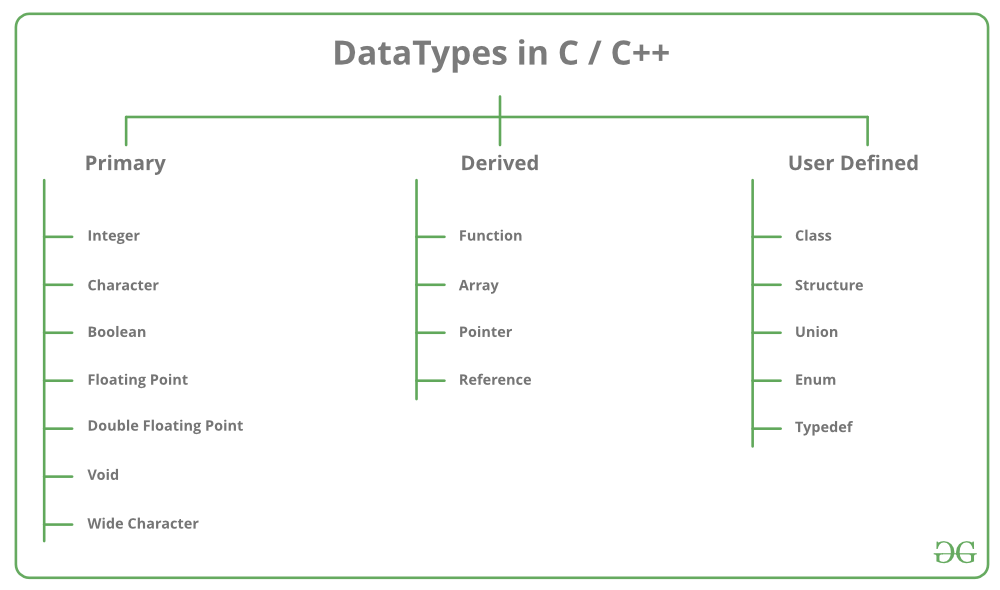
Let's learn about basic C++

C++ Data Types - GeeksforGeeks

Source: GeeksforGeeks

Loops in C++

For Loop

#include <iostream>
using namespace std;
int main() {
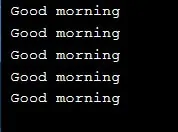
    for(int i = 1; i <= 5; i++) {
        cout << "Good morning \n";
    }
    return 0;
}

Loops in C++ 1

While Loop

#include <iostream>
using namespace std;
int main() {
    int i = 0; // Initialization
    while(i < 5) { // Test expression
        cout << "Good morning\n";
        i++; // Update expression
    }
    return 0;
}

Loops in C++ 1

Do-While Loop

#include <iostream>
using namespace std;
int main() {
    int i = 2; // Initialization
    do {
        cout << "Good morning\n";
        i++; // Update expression
    } while(i < 1); // Test expression
    return 0;
}

Output 2

C++ Interview Questions

1.

...
Continue reading "Comprehensive C++ Programming and Data Structures Reference" »