Notes, summaries, assignments, exams, and exercises for Computer science for Other courses

Key Concepts: Node.js Modules, Express Routing, Body Parser

Computer science6.67 KB

Understanding Node.js Modules & Core Functionality

In Node.js, modules are fundamental. They represent reusable blocks of code that can be exported from one file and imported into another, promoting a modular and organized application structure. Node.js features a built-in module system, allowing developers to utilize core modules, create custom modules, or integrate third-party modules.

Core Modules in Node.js

Core modules are pre-packaged with Node.js, offering essential functionalities for common tasks like file system operations, HTTP request handling, and path manipulation.

Some commonly used core modules in Node.js are:

  • fs (File System): For interacting with the file system.
  • http (HTTP): For creating HTTP servers and clients.
  • path (Path)
...
Continue reading "Key Concepts: Node.js Modules, Express Routing, Body Parser" »

Software Quality Assurance: Strategies, Testing, and Design

Computer science16.47 KB

Strategic Approach: Begins with technical reviews to identify errors early. Moves from component-level (unit testing) to system-level integration. Different strategies suit conventional software, object-oriented software, and web applications.

Strategies for Different Systems

  • Conventional Software: Focus on module testing and integration.
  • Object-Oriented Software: Emphasis shifts to classes, attributes, and their collaborations.
  • Web Applications: Covers usability, interface, security, and environmental compatibility.

Key Strategic Issues: Define requirements quantitatively before testing. Develop robust software with self-testing capabilities. Use iterative testing cycles to refine quality. Employ independent testers alongside developers.

Regression

...
Continue reading "Software Quality Assurance: Strategies, Testing, and Design" »

Web Mining: Usage, Content, and Structure Analysis

Computer science4.1 KB

Web Usage Mining

Web Usage Mining refers to the process of extracting useful insights and patterns from user activity on the web. It involves analyzing web log data (such as user clicks, page visits, and interactions) to understand user behavior, improve website performance, and enhance user experience. Web usage mining typically includes three key steps:

  • Data Collection: Gathering data from web logs, cookies, browser history, and other online interactions.
  • Preprocessing: Cleaning and structuring the data to eliminate irrelevant information and make it suitable for analysis.
  • Pattern Discovery and Analysis: Applying data mining techniques (e.g., clustering, association rule mining, and classification) to discover trends, user navigation paths, and
...
Continue reading "Web Mining: Usage, Content, and Structure Analysis" »

JavaScript Fundamentals: Quick Reference Cheat Sheet

Computer science2.61 KB

JavaScript Fundamentals Cheat Sheet

1. Variables

  • let: Used to declare variables that are block-scoped. This means they only exist within the block they are defined in (e.g., inside a loop or an if statement).
  • const: Used for constants, which are also block-scoped. Once assigned a value, they cannot be reassigned.
  • var: Declares variables that are function-scoped. This can lead to issues with variable hoisting and is generally less preferred in modern JavaScript.

2. Functions

  • Functions are reusable blocks of code designed to perform a specific task. They can take parameters (inputs) and can return values.
  • Functions can be defined in different ways, including traditional function declarations and arrow functions, which provide a more concise syntax.

3.

...
Continue reading "JavaScript Fundamentals: Quick Reference Cheat Sheet" »

Computer Science Keys: Types, Uses & Security

Computer science3.27 KB

Computer Science Keys: Types and Uses

Definition — Instance 1

In computer science, a key refers to a unique identifier or a combination of values that is used to:

  1. Identify a record or a row in a database table.
  2. Authenticate users or devices.
  3. Encrypt or decrypt data.

Types of keys:

  1. Primary Key: A unique identifier for a record in a database table.
  2. Foreign Key: A field that links two tables together.
  3. Unique Key: Ensures that each value is unique.
  4. Composite Key: A combination of two or more fields used as a primary key.
  5. Encryption Key: Used to secure data by converting it into an unreadable format.
  6. API Key: Used to authenticate and authorize access to APIs (Application Programming Interfaces).

Keys play a crucial role in maintaining data integrity, ensuring...

Continue reading "Computer Science Keys: Types, Uses & Security" »

Comprehensive C++ Programming and Data Structures Reference

Computer science8.72 KB

C++ Fundamentals

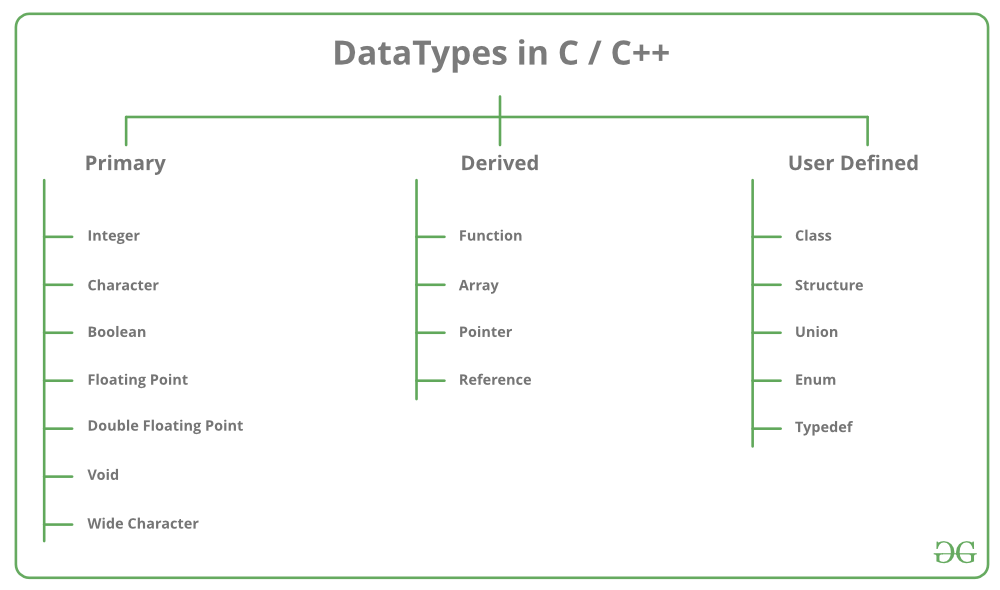
Let's learn about basic C++

C++ Data Types - GeeksforGeeks

Source: GeeksforGeeks

Loops in C++

For Loop

#include <iostream>
using namespace std;
int main() {
    for(int i = 1; i <= 5; i++) {
        cout << "Good morning \n";
    }
    return 0;
}

Loops in C++ 1

While Loop

#include <iostream>
using namespace std;
int main() {
    int i = 0; // Initialization
    while(i < 5) { // Test expression
        cout << "Good morning\n";
        i++; // Update expression
    }
    return 0;
}

Loops in C++ 1

Do-While Loop

#include <iostream>
using namespace std;
int main() {
    int i = 2; // Initialization
    do {
        cout << "Good morning\n";
        i++; // Update expression
    } while(i < 1); // Test expression
    return 0;
}

Output 2

C++ Interview Questions

1.

...
Continue reading "Comprehensive C++ Programming and Data Structures Reference" »

Data Models, Schemas, and Database Normalization

Computer science3.46 KB

Categories of Data Models

  • Entity: Represents a real-world object or concept.
  • Attribute:
    • Represents some property of interest.
    • Further describes an entity.
  • Relationship: Represents an association among two or more entities.
  • Entity-Relationship model
  • Relational data model: Used most frequently in traditional commercial DBMSs.
  • Object data model:
    • New family of higher-level implementation data models.
    • Closer to conceptual data models.
  • Physical data models: Describe how data is stored as files in the computer.
  • Access path: Structure that makes the search for particular database records efficient.
  • Index:
    • Example of an access path.
    • Allows direct access to data using an index term or a keyword.

Schemas, Instances, and Database State

  • Database schema: Description of a
...
Continue reading "Data Models, Schemas, and Database Normalization" »

PAL Color Television System: Key Components & Functions

Computer science3.45 KB

Color Subcarrier Oscillator Fundamentals

The color subcarrier frequency must be very precise. To generate this precise frequency, a crystal oscillator is used. Its features include:

  • It operates at very specific frequencies.
  • Frequencies are easily synchronizable.
  • To correct the oscillator signal, the principle of correction by Phase-Locked Loop (PLL) is used.

The crystal circuit has three differentially-controlled phase parts:

  • The crystal oscillator provides a frequency signal, which can be stable and regulated.
  • The phase comparator provides the control voltage.
  • Phase reactance varies the oscillator capacitance.

PAL ID Circuit Function

The PAL ID circuit provides essential information to both the color suppression circuit and the PAL switch.

PAL Decoder:

...
Continue reading "PAL Color Television System: Key Components & Functions" »

Core Network Communication Protocols and Distributed Systems Explained

Computer science3.78 KB

Understanding Network Communication Models

Client-Server Communication Model

In the Client-Server model, one process (the server) executes orders or commands requested by another process (the client).

Distributed Applications

Distributed applications consist of different programs that may be located on various machines, such as client and server machines, working together to achieve a common goal.

Network Communication Layers

Network communication can be conceptualized at different levels:

  • Application Layer: Deals with the communication processes of application components.
  • Physical/Architectural Layer: Focuses on the physical transmission of information.

Protocols and Services

  • Protocol: A set of rules governing communication between two entities at a
...
Continue reading "Core Network Communication Protocols and Distributed Systems Explained" »

Network Topologies, Protocols, and Architectures

Computer science2.42 KB

Network Topologies

Ring Topology

Connects hosts in a physical ring. The last host connects to the first.

Star Topology

Connects all cables to a central point.

Extended Star Topology

Connects individual stars using hubs or switches, extending network coverage.

Hierarchical Topology

Similar to extended star, but uses a computer to control traffic instead of hubs/switches.

Mesh Topology

Provides maximum protection by connecting each host to others, ensuring service continuity.

Network Communication Methods

Broadcast

Each host sends data to all others on the network. Access is first-come, first-served (e.g., Ethernet).

Transmission Tokens

Controls access via sequential token transmission. Hosts send data when they have the token (e.g., Token Ring, FDDI).

Network

...
Continue reading "Network Topologies, Protocols, and Architectures" »